










Shell's new PC-12 engine oil is a heavy-duty lubricant developed through rigorous testing that meets new API CL-4 and FB-4 specifications, offering improved wear protection, better fuel efficiency, and enhanced aftertreatment performance for modern diesel engines while remaining backward compatible with older fleets.
- Two formulation tracks: CL-4 for traditional engines and lower-viscosity FB-4 (0W-20, 5W-20) designed for newer engine platforms
- Development process: Shell's scientists conduct extensive testing including lab simulations, field trials with real fleets, and digital engine piston analysis to measure performance
- Key improvements: Enhanced resistance to oil breakdown, increased wear protection, improved emissions control, and better fuel economy compared to older formulas
Jesus Salinas, lab technician at Shell Technology Center Houston says making an engine oil is like making soup.
“So 90% of it, just like a soup, is going to be the broth — the base oil,” Salinas says. “And then after that, it’s going to be the small little things that give it the flavor.”
Those are things that help protect the engine, control emissions, extend oil drain intervals and more. STCH is where, for Shell Rotella, all those things get worked out before a final product is released to the commercial vehicle industry.
Labs strung across the 200-acre, 40-plus building STCH site work out which base oils and additives will blend together to make an oil that works hard, both for the engine it’s in and for the planet.
“We see ourselves as an energy company,” says Dr. Jason R. Brown, general manager of lubricants technology industry and support. “At the end of the day, our goal is to provide cleaner, better energy sources for the future."
One of those sources is a new PC-12 engine oil that meets API CL-4 and FB-4 specifications. CL-4 replaces CK-4 and is fully backward compatible with older and mixed diesel fleets. It covers higher viscosity grades, such as 15W-40 and 10W-30. FB-4 is lower viscosity — 0W-20 and 5W-20 — and is designed for newer engine platforms.
The new Rotella oils, Shell says, are an improvement over older formulas, with improved resistance to oil breakdown, improved aftertreatment performance, increased wear protection and lower viscosity capabilities to drive better fuel performance.
“As diesel engine technology continues to evolve, our customers need products that protect the equipment they rely on today while helping them confidently prepare for what comes next,” says Julie Wright, brand manager for Shell Rotella.
 Used parts await examination at the Shell Technology Center Houston after being used to test an oil. Beth Colvin / Trucks, Parts, Service
Developing a new oil
Research and development is where STCH — and Salinas’ seasoning — comes in.
Sarah Lawrence, global product manager, gave an overview of Shell’s engine oil development processes recently at STCH. The new oil performance categories are necessary, she says, as more strict emissions regulations are forcing efficiency and emissions gains in diesel engines. Those engines then require a higher level of lubricant performance to maintain the engine and its components, including aftertreatment devices.

 Sarah Lawrence, global product manager for Shell, talks about the development process for a new heavy duty engine oil. Beth Colvin / Trucks, Parts, Service
“(The oils) have to be able to work under the most strenuous conditions, different operating temperatures,” Lawrence says. “They’ve got to do it with more and more strict controls of what you can and can’t use. It’s a real journey.”
[RELATED: DEF solves emissions problems but needs its own maintenance]
The development of Rotella’s PC-12 oil started, she says, years ago and followed an exhaustive road map of formulation, testing, adjustments, retesting, spec’ing, field trials and more.
“We build our Rotella products to meet our customers’ needs, industry standards and really, for Rotella, we like to build high-performing lubricants,” says Patrick Joyce, project lead for heavy-duty engine oil at Shell.
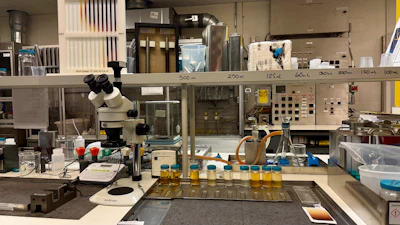
 A lab tech at Shell Technology Center Houston holds samples of oxidized oil formulations.Beth Colvin / Trucks, Parts, Service
Hitting the lab
There are more than 200 labs on the STCH campus where more than 1,700 scientists and engineers work on things like the new heavy-duty engine oil category. Machines, scientists and engineers mix, freeze, roast and burn blends of Shell lubricants, pushing the limits of what they can take. It sounds complicated, but Salinas said it’s really pretty simple. Just like soup.
“So you got your protein, your vegetables, salt, pepper and all that stuff, right,” Salinas says. “It’s kind of something with formulating engine oils. You have your base oil … and after this, you have your additional additives. That’s the little things we tweak, a little bit more salt, a little bit more pepper.”
Shell works with industry standards like those developed by API, but also with OEMs and component manufacturers.
“One thing I like about the engine oil is it touches almost every component in the engine,” says Patrick Joyce, project lead, heavy-duty engine oil. “It’s the lifeblood of the engine. It flows everywhere, lubricates everything.”
The engine oil must be compatible with every component of the engine, so as OEMs are developing engines, Joyce says Shell is working right alongside them. The industry standards set a minimum, but working with the manufacturers, the company can make sure its oil work well across the spectrum of applications.
 Matt Urbanak, associate technology manager for heavy-duty engine oil, points out used engine parts after a Shell Rotella field test. Beth Colvin / Trucks, Parts, Service
Testing the blends
PC-12 will be Matt Urbanak’s last Rotella roll-out. The associate technology manager for heavy-duty engine oil worked on the PC-10 development in 2006, the development of PC-11 oils in 2016, and now, PC-12. He’s been part of the Rotella team since 2003 and has been in the industry for 34 years.
“We utilize a dual development strategy. We have a mix of products,” Urbanak says, fit for purpose and differentiated. Fit for purpose products do the job, he says, and are cost effective. They work for the minimum period someone will own the truck. Differentiated products are more of a premium engine oil designed for severe-duty applications or other uses beyond normal, including for customers who just want the best oil in their trucks.
Shell tests its oils according to API and OEM standards, but it also runs a variety of field tests to ensure the products are performing as they did in the lab on the road. They can also push the limits of the tests, extending oil drain intervals for example, to really measure how the oil will work.
 A disassembled engine on display at Shell Technology Center Houston. The team at Shell tests oils and lubricants in the field, then tears down engines to see how they performed. Beth Colvin / Trucks, Parts, Service
“We know the customers who use our oils sometimes have to make decisions where they can’t get to the next oil change. They’ve got to drive a little longer. They’ve got to go a little further on that,” Salinas says. “Having this kind of information helps educate us about what to tell customers about what’s the right oil for the way they use the equipment.”
Urbanak detailed some of the test fleets Shell uses, including a long-haul over-the-road fleet and equipment used in mining and agriculture, as well as pickups, local delivery trucks and New York City taxis. The company also tested drain intervals, all with fleets who don’t know exactly what oil they’re getting, he says. The samples are named after sports figures.
And checking those field test engines? STCH has a lab for that too.
While scientists at the lab can do a complete engine tear down, Urbanak says most of those take place close to test fleets, with parts then shipped back to STCH for a closer look. There, each part is scrutinized to see how the test oil performed in real world work.
In another lab, a scanner makes a digital twin of an engine piston, mapping out where and how thick carbon deposits are on the part.
“The challenge is that everything is black, right,” Urbanak says. “The piston is black. It’s hard to see the deposits that are built up in there.”
This enables Shell to compare the performance of fit for purpose and differentiated oils as well as how its oils compare to competitors’ blends.
PC-12 on the shelves
While the effective date for the new category of oil is Jan. 1, 2027, Shell says its rollout will be more gradual. Bulk fill customers will get the oil first and bottles will start landing on shelves later in the first quarter, says Ann-Christin Lentfer, global product and portfolio innovation, commercial road transport.
Shell also has commitments to factory-fill engines with the new oils. It’s not at liberty to say which ones, but stresses it’s been filling engines in Europe with the newer, low-viscosity oils for years.
“It’s not necessarily a new rodeo for us,” Brown says.