










Talks between the U.S. and Mexico started Thursday aimed at reviewing the United States-Mexico-Canada Agreement (USMCA). Missing from the talks: Canada.
Jeff Goettman led a U.S. delegation to Mexico City for talks this week that will focus on economic security and rules of origin for key industrial goods, including cars and trucks assembled in Mexico. Another round will come June 16-17 in Washington, D.C., to discuss agriculture and a level playing field. A third will be the week of July 20 in Mexico City.
Dominic LeBlanc, the Canadian minister responsible for Canada-U.S. trade, says he’s planning to travel to D.C. for negotiations, but no dates have been confirmed. LeBlanc did meet with U.S. Trade Representative Jamieson Greer in March, and in April, Canadian Prime Minister Mark Carney says the U.S. wouldn’t get to dictate the terms when it came to the USMCA.
“We understand what some of the Americans would call trade irritants or trade issues are,” Carney said. “We have some on our side as well. We will sit down and work through those issues with the broader approach in the negotiations. It’s not a case of the United States dictates the terms. We have the negotiations. We can come to a mutually successful outcome.”
But, he added, it will “take some time.”
MEMA, The Vehicle Suppliers Association, says renewing the USMCA is its top priority this year, calling the trade pact the foundation of modern vehicle manufacturing.
“The 2026 review is an inflection point; weakening the agreement now would disrupt active investment and threaten manufacturing jobs,” MEMA Vice President of Public Policy Bill Frymoyer said.
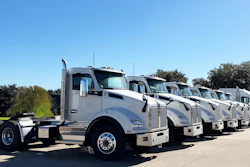
More than 40% of Class 8 trucks sold in the U.S. are imported from Canada and Mexico, S&P Global says, with Mexico being one of the largest importers of medium and heavy duty trucks into the U.S. The country sent more than $120 billion in heavy duty truck parts into the U.S. last year. Since the USMCA and the North American Free Trade Agreement before it, the number of commercial trucks imported from Mexico and Canada has more than doubled, S&P Global says, and now represents nearly a third of U.S. new vehicle demand.

The Trump administration levied a 25% tariff on medium and heavy duty trucks late last year. That tariff action, unlike the tariffs struck down by the Supreme Court, is a Section 232 tariff. It was enacted after a Commerce Department investigation into the national security implications of truck imports. Trucks that strictly meet the USMCA’s criteria of 64% of a truck’s value, including core components and assembly labor, originating in North America — those rules of origin — are still exempt. Parts are also included in that tariff, and the administration launched an offset program to give credits to 3.75% of the aggregate value of assembled trucks domestically. In a recent webinar, FTR says the economic impact is about 4.8% on the average new Class 8 vehicle.
Trump and his allies have asserted actions such as tariffs will help draw manufacturing back to the U.S., and that is also the administration’s aim as the USMCA review starts.
“We need to adjust rules of origin,” Greer told the House Ways and Means Committee earlier this month. “In Trump’s first term, working with this committee, we adjusted the rules of origin for automobiles and that drove more investment in automotive production in the United States. We need to take that model and we need to take it to other goods as well … to make sure that our manufacturers have an incentive and a comparative advantage relative to others.”