











Here’s what you need to know:
- Genuine Parts Company will separate into two independent, publicly traded entities — Global Automotive and Global Industrial — by the first quarter of 2027 to unlock long-term shareholder value and improve operational clarity.
- The Global Automotive business will target growth in the “do it for me” (DIFM) market through private label expansion and supply chain efficiencies.
- The Global Industrial business become a consolidation leader in the fragmented industrial distribution landscape by prioritizing strategic acquisitions.
The desire to unlock long-term value for shareholders while enhancing operating clarity across business units are among the reasons why Genuine Parts Company (GPC) will separate its operation into two distinct public companies in 2027, the company recently announced.
Citing meaningful progress over the past decade in developing leading and distinct distribution platforms with scaled leadership structures in the global automotive and industries markets, GPC states now is the perfect time to disentangle the two operations, unlocking value that better positions each company in the years ahead.

How will the business be split?
In its February announcement to shareholders, GPC’s board of directors said it intends to separate the independent Global Automotive and Global Industrial entities by the first quarter of 2027.
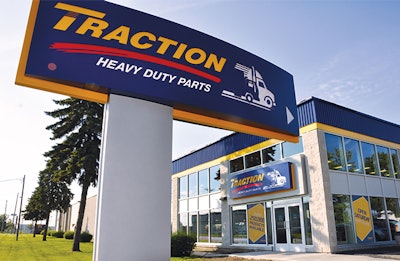
The Global Automotive business, which will include valued brands such as NAPA Auto Parts, Repco, Traction Heavy Duty and more, will stand as the largest global network of automotive parts and service centers, responsible for $15.4 billion in fiscal year 2025 sales with EBITDA of $1.2 billion.
[RELATED: More than 2,000 laid off by First Brands as business disintegration continues]
The Global Industrial business, anchored by the Motion Industries brand, accumulated $8.9 billion in FY 2025 sales with EBITDA of $1.1 billion.
GPC reports the Automotive unit’s leading presence in the growing commercial ‘do it for me’ (DIFM) market as a key point of value for that unit, while the Industrial unit stands as a premier strategic partner in large, highly fragmented addressable market.
What must be done to complete the separation?
GPC is working to scale the leadership structures of both units, adding seasoned executives with expertise in both industries and knowledge of how to expand revenue opportunities highly fragmented markets.

GPC also states it is targeting to maintain investment-grade credit metrics — with tailored capital structure to support investment on the Automotive side and capital allocation to prioritize investment in customer experience on the Industrial side.
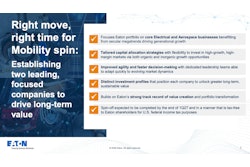
[RELATED: Eaton wants to spin off its truck business. Why?]
The company states it will continue prioritizing organic investment and accretive bolt-on acquisitions for the Automotive unit, with Motion continuing to pursue strategic acquisitions and a balanced capital return program on the Industrial Side.
What is the growth potential of the two units?
GPC believes its Global Automotive business revenues can be enhanced through investments in commercial excellence and the expansion of private label brands, as well as supply chain investments that reduce cost and drive operational efficiencies.
Within the Global Industrial business, GPC believes strengthening its core market presence to pursue leadership in high-growth, value-added segments as a compelling growth strategy. The company also believes it can be a consolidation leader across the industrial distribution landscape.
The separation will enable a focused investor message, which GPC states “enables each business to attract a long-term investor base through a clear, compelling and differentiated investment profile.”
The company also states through tailored capital allocation, each business will be able to design capital structures and strategies “aligned with specific business objectives, while targeting investment-grade credit metrics at each company.”