










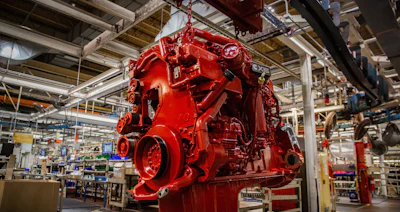
Cummins' engine and components sectors powered a 13% year over year increase in third quarter revenues, which totaled $9.4 billion.
"While the U.S. medium- and heavy-duty truck markets strengthened, customer orders in the pickup truck market have weekend," says Jennifer Rumsey, chair and CEO. "I'm proud of our employees' focus on execution and confident our market-leading positions and broad portfolio will enable us to continue to deliver for customers, improve our financial performance cycle-over-cycle and return cash to shareholders."
[RELATED: Truck OEMs reveal mixed 2027 engine production plans]
The engine segment saw sales jump 20% to $3.1 billion, with revenues in North America up 21% on stronger truck demand. The component segment was up 23% to $2.9 billion, with North American revenues up 35%, also on stronger truck demand.
According to RigDig (owned by Fusable, parent company of TPS), there are 844,558 verified vehicles running on Cummins engines in the U.S. alone.
Cummins also dialed in its 2026 outlook, projecting revenue growth of 10% rather than its prior guidance of 10-13%.
"We have adjusted our full-year revenue and profitability guidance primarily due to continued weaker than expected pickup truck demand in North America, which impacted our third quarter and is expected to persist through the end of this year," Rumsey says. "Global power generation and North America heavy duty truck demand remain strong and we expect fourth quarter revenues to step up from third quarter levels and set a new record.
Cummins expects engine revenue to end the year up 8-11%, with components coming in nearly the same. Distribution should be up 10-13%, with Accelera notching revenue of $350-$400 million.
It forecasts the heavy duty truck market for North America to be up 10-15% and medium-duty to end the year up 15-20%.
In this quarter, the Accelera zero emissions segment stayed in the doldrums with sales dropping 15% to $103 million and an EBITDA loss of $56 million, mainly due to battery and electric powertrain development. However, the company says it remains committed to pacing and focusing its zero-emissions investments on the most promising paths to ensure long-term success while at the same time reducing losses.