











‘What engines are we going to sell next year?’ is not a question truck dealers typically ask. But 2027 is not going to be a typical year.
As the trucking industry awaits the finalization of the EPA 2027 NOx rule, July’s announcement the rule will likely provide engine and truck manufacturers multiple pathways to regulatory compliance has created a unique fall order season. Every heavy-duty diesel engine maker supporting the Class 8 space has developed an EPA 2027-compliant engine, but those same manufacturers are mixed on if those engines will actually hit production lines when the calendar turns over in January.
It is with that in mind that Trucks, Parts, Service recently connected with the truck and engine makers to ask what their 2027 engine plans are and how they are preparing customers and dealer partners for the complex year ahead.
Cummins
As the largest commercial truck engine producer per RigDig (owned by Fusable, parent company of TPS), interest in Cummins’ engine plans has been high all year.
Weeks after the proposed changes to the EPA 2027 NOx rule were published in July, Cummins announced plans to phase in its 2027-compliant engines across the medium- and heavy-duty truck sector next year, utilizing the “implementation flexibilities” outlined in the proposed rule.
The company stated its model year 2027 X15 engine will enter limited production in January and ramp up as the year progressed. Other MY 2027 engines will launch similarly or in 2028, and company exec James Hopkins confirmed in September that Cummins will pass through non-conformance penalties (NCP) where applicable.
[RELATED: TPS survey shows dealers outpaced aftermarket in Q3]
“As the industry transitions to MY2027, we are focused on providing customers with clear and consistent information to support product specification and purchasing decisions,” Cummins told TPS. “We are working closely with our OEM customers and commercial teams to help fleets understand product availability, application considerations and the value delivered by our certified engine offerings.”

Daimler Truck North America
Out west, the nation’s largest truck producer by market share is taking a different approach.
Though Cummins’ engines are available in Daimler Truck North America’s Freightliner and Western Star truck brands, the OEM states it is fully committed to bringing its proprietary, credit-supported EPA-compliant 2027 engines online next year.
“All Detroit engines offered for model year 2027 comply with EPA’s 2027 requirements,” Mike Young, manager of powertrain and safety product marketing at DTNA, told TPS. “The Detroit Gen 6 DD13 and DD15 meet the EPA 2027 emissions standards without relying on nonconformance penalties.”
Young also noted DTNA has been training its dealer partners this fall to sell and service these new engines, and believes the similarities between its current engines and Gen 6 designs work to its advantage.
“Gen 6 is an evolution of Detroit’s established heavy-duty engine platform, not a clean-sheet design,” he said. “Approximately 75% of its core components carry over from the previous generation, preserving many of the operating and service characteristics customers and technicians already know.”
[RELATED: OEMs stand ready to meet EPA’s new NOx regulations]
He added, “Dealers are prepared to explain what remains familiar, what has changed and how those updates affect vehicle operation and service.”
International Trucks
A similar tactic will be leveraged at International.
David Hillman, the company’s vice president of Integrated Technology Sales, and Kevin O’Brien, pricing director, report International will offer its fully compliant S13 Integrated Powertrain along with various Cummins’ engines in its medium- and heavy-duty vehicles in 2027.
“We are excited about the minimal changes required and customer benefits we are delivering with our EPA 2027 version of the International S13 Integrated Powertrain,” the duo told TPS.
Hillman and O’Brien believe the S13 offers “the least disruptive technology path” in the market to meet EPA 2027 requirements, but also acknowledge the “flexibility of implementation proposed in the recent new proposed rulemaking should help ease the customer transition during the first half of 2027, resulting in a more stable order and production environment throughout the year.”
The pair said International’s fourth-quarter training has and will continue to focus in that area, “actively discussing the impacts facing the industry and choices customers will have to make due to regulations.”
Paccar
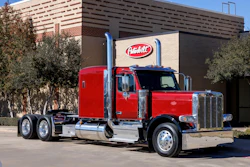
Kenworth and Peterbilt chose not to comment to TPS regarding their 2027 engine portfolio, but their parent company Paccar did tell CCJ it will only sell its current generation of MX engines for an “undefined period” next year.
Paccar also reported in its second-quarter earnings call its intent to continue offering current engine configurations that do not meet 2027 regulations while ramping up its release of its own compliant engines throughout the year.
[RELATED: Judge clears the way for Paccar MX-13 class action to go to trial]
Volvo Trucks North America
A multi-pathway launch also the plan for Mack Trucks and Volvo, the companies told TPS. Both companies have access to fully compliant MY 2027 engine technology, and will complement that offering with existing technologies to give customers choices in how to proceed.
“Mack has a long history of helping customers adapt to industry change, and emissions regulations are no exception,” Jonathan Randall, president of Mack Trucks North America told TPS. “We will offer both our EPA 2024 and EPA 2027 solutions for customers to give them a choice. Mack also will continue to deliver proven technologies and expert support that allow fleets to choose the solution that best fits their application, investment strategy and long-term business objectives.”
“Sustainability has always been a core focus for Volvo Trucks, and EPA 2027 marks another step toward reducing environmental impact across the transportation industry,” added Volvo’s Magnus Koeck, vice president of strategy, marketing and brand management.
“Customers will have the flexibility to choose between our EPA 2024 solution and our new EPA 2027 solution. We remain committed to helping customers navigate the evolving regulatory landscape while providing guidance on the technical solution that best supports their business performance.”