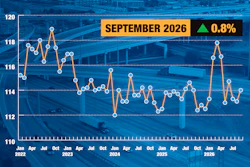












Inflation for heavy-duty truck parts has cooled significantly over the course of 2026, though overall prices remain well above pre-2024 levels, according to the latest Heavy-Duty Price Index (HDPI) released by online marketplace FinditParts.
The industry-wide index, which tracks millions of stock-keeping units (SKUs) across roughly 900 inventory locations nationwide, sat at 105.7 in September 2026, indicating that overall pricing is up 5.7% compared to the baseline set in January 2024. However, year-over-year pricing growth has steadily moderated since the first quarter of the year, settling at a modest 1% increase by September.
FinditParts measures price trends on a SKU-by-SKU basis using a matched-item approach similar to the government's Consumer Price Index (CPI), evaluating the same items at the same locations month-to-month.
The report highlights distinct trends across different segments of the supply chain and product categories:
Distributors vs. manufacturers: Distributors experienced moderate price pullbacks in 2024 followed by sharper increases in mid-2025, while manufacturers saw more consistent inflationary pressure starting in 2025, pushing manufacturer pricing up 1.9% year-over-year by September 2026.
Driveline and axles: This category experienced significantly higher inflation than the broader heavy-duty market through late 2025 and early 2026. Although growth slowed in the third quarter of 2026, pricing in the category remains up 12.9% compared to January 2024.
HVAC: Heating, ventilation, and air conditioning parts followed a more volatile path, remaining deflationary through much of 2025, posting moderate gains in the first half of 2026, and turning deflationary again in the second half to sit roughly flat overall since January 2024.
By comparison, broader government inflation benchmarks have painted a mixed picture for motor vehicle parts. While the Bureau of Labor Statistics' CPI suggests moderating inflation for motor vehicle parts and equipment (up 0.9% year-over-year in August), the Producer Price Index (PPI) for motor vehicle parts manufacturing showed stronger inflationary momentum at 3.3% over the same period. Industry experts note that the HDPI provides crucial localized visibility into heavy-duty commercial shelves that broad consumer and producer indexes cannot capture.
What's happening with heavy duty truck parts prices and how fleet managers can navigate rising maintenance costs?
Hey everybody, welcome back. I'm Jason Cannon and my co-host is Matt Cole.
Truck fleet managers are facing continued cost pressure is heavy duty. Truck parts prices remain elevated, while overall inflation has cooled just a little bit from 2020. For a new heavy duty price index from finding parts shows that truck prices are up 5.7% overall compared to January of 2024.
Standard. Government benchmarks like the Consumer Price Index and Producer Price Index don't accurately reflect the heavy duty commercial vehicle parts market.
Find at parts, granular index tracks millions of SKUs revealing that input costs, commodity pricing, labor rates, and manufacture price passing are driving increases unevenly across categories like drive lines and axles.
manufacturer pricing has trended upward, up 1.9% year over year in September. Distributor prices have only ticked up 0.2%, suggesting parts distributors are not passing along the full brunt of cost increases. But there is typically a 1 to 3 month lag before manufacturing increases hit distributors, meaning fleets could see more price pressure ahead as distributors balance price elasticity. With consumer demand
I mean, the individual drivers, you know, and again, the way we look at the data and the way we kind of break it down is obviously we've kind of reported data on an aggregate level. So just a couple of comments, as we get into your specific question, you know, when we look at some of the big metrics around like CPI and PPI that are, produced by the government on the monthly basis, really as it relates to our industry in terms of heavy duty truck parts and those sort of things. just simply not representative of what we're seeing in the space. And again, just to kind of hammer that home, then answer your question. You know, really all that we're being reported on in terms of our industry, when we look at the overall numbers, is is basically just what tires are doing, right? Automobile tires really when you look at it.
So we decided given all the information we've got on prices, let's get really specific and create an index that is frankly far more granular than the overall US government, CPI and PPI in terms of how many prices and SKUs they're looking at, is really more relevant to our overall industry and in more specifically, relevant to distributors, manufacturers and the categories are within heavy duty.
So when we kind of back and answer your question about what we're seeing with manufacturers, what we're seeing distributors, really, the way we kind of look at it is on a category by category basis. within that, you do see a lot of different inputs, whether it's input cost, commodity prices, commodity components that are going into certain categories.
But we were kind of really surprised by when we started to do our category cut of that data here for our first report is, geez, I mean, you know, drive lines and axles were had major kind of inputs on the inflationary side from a manufacturer perspective. And really when you trace that back, that goes back to a lot of the general, inflationary inputs we're seeing in the overall economy, but we're seeing that very differently impacted when you get down into the category level.
And again, back to your question why? A lot of it is dependent on, again, the a couple of things. What are those input costs that are going into what a manufacturers building, what's happening with certain labor costs and certain labor specialties. And then frankly, at the end of the day, a manufacturer's view of how much of that price increase that they're having on a cost input side, that they think they can pass along to customers as well.
I think there's there's a couple of things are happening. It is a little bit surprising. One, I think when you look at the data that we've laid out, you look at the difference between manufacturer pricing trends and distributor trends, one thing I will note is there's about a one to 2 to 3 month lag when we see a manufacturer action or manufacturer price is being taken up to in.
It's fully realized by the distributors. So, you know, right now, what we saw in our September report was manufacturing pricing was up about 1.9%. You know, year over year for the month of September 2026.
at the distributor level, it was only up 0.2%. So that's a pretty big difference. What we think we're going to see, in subsequent reports in subsequent months is that increase that originally has happened for the manufacturers. We're starting to flow more to the distributors. And so I think one, there's a timing issue of just where the pricing impacts are felt with your manufacturer or your kind of natural way that rolls out.
then, too, I do think you're right. There is an element of both manufacturers and distributors trying to understand their own customers price elasticity curves how much of that cost they can pass on, how much cost they can't pass on. So they remain price competitive in the categories and in the purchase considerations. They have to.
I think it's a little bit of a balance. I think you're seeing some timing. I think you're going to see more pressure on distributors when we report next month. that's my hypothesis.
And I do think that both manufacturers and distributors are trying to understand just how much they can pass on before it really starts to impact their volume.
when parts prices climb or availability. Titans fleets often resort to familiar coping mechanisms like cross-referencing aftermarket parts, cannibalizing part trucks for components, or deferring non-essential maintenance until a tipping point is reached.
And we do think there's a lot of downstream impacts. I mean, I think one, first and foremost, you start to utilize some of the data that that departs has around just cross-reference and parts interoperability. And it may be that you don't buy the OEM part. You know, going forward you buy an aftermarket part, it's cheaper, it's more available, what have you. I believe that is very much a thing there.
And we expect that trend occur as well. There's also general trend that we've seen when you do have things like parts availability or parts pricing increasing parts of eligibility becoming harder to find, his fleet start cannibalizing trucks that are sitting on lots and, you know, you start to see some of that behavior over time until, frankly, you just get to a tipping point where you can't defer any more maintenance, you can't pull parts off another truck that you may have, you know, sitting in a lot, that it does kind of flow back into parts sales increasing.
That's been a an overall cycle that we've noticed going back, you know, a couple of decades. It's pretty consistent the way the pattern and the behavior works out. we expect to see that, you know, be the case here as well.
for maintenance managers gearing up for seasonal and winter upkeep. Matthew emphasizes the importance of utilizing granular data instead of relying on high level anecdotes. Shops can optimize inventory and gross margin return by examining regional and category specific demand signals.
so my background just, you know, to answer that question, you know, I've come from retail distribution and, you know, other industries you do see, you know, a lot more, detailed data that helps folks like, know, that's running the shop, understand what inventory to kind of build based on demand signals, based on regional signals based on supply chain availability or not.
so what I would say is, you know, as we're starting to enter into a period potentially of increased prices and hard, refined inventory really understanding the balance of what you've got on the shelf vis a vis what you're likely demand is going to be for services in any place, that there are stresses within that, where there may not be available inventory or there may be long lead times on inventory, or you may see big pricing trends on inventory really, frankly, just utilize the data.
And I think that that's what we're really trying to do to find a parts is, for our industry, a lot of what, you know, folks have had to rely on historically has been very high level anecdotal, you know, survey based data, unsubstantiated data. But we'd recommend is, look, if you're looking to do the things that a shop or retailer or distributor should be doing, know, which is optimizing inventory, optimizing your gross margin return on inventory, making sure you don't fire customers by not having availability or access to parts is to really understand that that data at a more granular level to help your own planning.
And so that's really what we're trying to do with these tools is, each individual, company and participant industry has to figure out how to utilize this sort of data in their own way, but we're just trying to turn the lights on for folks to help them understand what's likely to come.
Now, to truly weaponize this data, fleets have to look beyond the headline numbers and examine regional stocking levels or manufacturers over indexes.
Before we get into that and how your parts budget might look next year, we're going to hear from our sponsor, Chevron Lubricants.
What's on the line for your business today? Trust your next contract. Your reputation. Truth is, it's all on the line every day. Which makes your choice of diesel engine oil a critical decision. Keep equipment on the job with the only ultra low ash, heavy duty engine oil that reduces clogging to extend DPF life, increases drain intervals, and improves fuel economy.
When everything you work for is on the line, choose Delo.
And I think that's where, you know, we're excited to help out. And so I'd say the best way to weaponize this is, first off, reach out to a gentleman we have helping to manage this on our side. named Kevin Leydig. He's our VP of business development.
And really, what we've kind of given you the report, again, heavy duty truck parts, know, price index is an aggregate view. But I think in order to weaponize it to make sure we understand what a fleet manager or other folks might utilize, you want to have a deeper cut down.
And that's where we have really robust data at a deeper level. So again, what I would say, look, if you are in the northeast, my answer to how to weaponize and what to do is going to be very different than if you're in Southern California.
If you over index on certain manufacturers and your repair shops, how you think about inventory and availabilities can be very different than if you are an. IRF has, you know, a different kind of set of trucks that you typically work on or a broader array.
So I'd say the best way to weaponize it is, you know, frankly, just reach out to us and let us help get those folks the deeper cut that are most relevant to their geography, what they tend to serve, who their customer base is, because that's really what the unlock is.
It's great to have this headline data, which we're we're proud of because it hasn't really exists historically. But really where the magic is, is when you're able or we're able to help slice and dice very specific to who that end customer is and what their needs are.
Looking ahead to the end of the year and into 2027, Matthew expects continued upward pressure on manufacturer pricing to trickle down through distributors in Q4. Keeping maintenance costs high alongside other operational expenses like soaring diesel prices.
we're reporting this data and learning our own view of the interplay between HTP and kind of broader inflation in real time.
You I think what's really interesting is what we try to do is give our signal on price inflation right before the government, release theirs.
And if you look at what the government leased, know, earlier in the day, inflation is up inflation is a pretty high level. We haven't seen this sort of uptick in a while. What I think is interesting, again, when you go back to our data, you look at our manufacturing index like it's up and it's kind of following that same general trend that we're seeing.
We just have a slightly more advanced look at it versus the overall CPI. So what does that mean the rest of the year.
You right now we are starting to see the beginning of a trend back up in terms of pricing on you. And I believe that's going to leak through over distributors for the rest of the fourth quarter of this year and probably into next year.
again, I think the real interesting piece, which we, know, spend a lot of time on is, again, that variance in those prices increases and the pressures on the category level. Because just for perspective, even what we saw last month alone, was almost a 13% difference in terms of pricing moves between categories.
And so again, in aggregate, I think we're going to see a little bit of upward pressure for the rest of this quarter and into next year.
I think what's going to be most dramatic is those individual categories and how those move.
Well knows my the cost of my diesel here in Newport Beach, California is like almost nine bucks. So that isn't helping. And then, yeah, I think we're going to have some pressure, know, on the part side as well.
it for this week's 1044.
You can read more on cc j digital dot com.
While you're there, sign up for our newsletter and stay up to date on the latest in trucking industry news and trends. If you have any questions or feedback, please let us know in the comments below. Don't forget to subscribe and hit the bell for notifications so you can catch us again next week.