










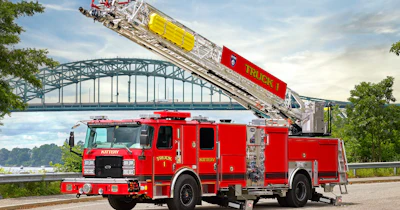
Fire trucks, the National Fire Protection Association (NFPA) says, shouldn’t be serving on a city or county’s front lines past 15 years old. But fire chiefs around the country report their trucks could, at the very least, vote and, at worst, nearly qualify for Social Security payments.
Dennis Rubin, chief of the Kansas City Fire Department, testified about the aging fire truck fleet before a Senate committee in September.
[RELATED: Landmark 1,000th Paccar MX-13 goes into Louisiana fire engine]
“The current generation of fire chiefs are witnessing, with seemingly little reaction, an epic fire apparatus crisis unfolding without much pushback,” Rubin told the committee. Not only could his department not find available trucks to refresh its fleet, Rubin and other chiefs around the country say wait times for trucks have as much as quadrupled since the COVID-19 pandemic and prices have more than doubled.
Part wait times are also increasing.
“Replacement parts are not readily available today to make the needed repairs to keep Big Red on community watch,” Rubin said in September. “Repair parts are purchased by the largest fire apparatus manufacturers from other specialty manufacturers (e.g., transmission and other power train parts). By simply slapping on the fire apparatus manufacturer’s part number and label, the repair parts get an instant price increase to the consumer. With a simple re-labeling, these repair parts become original equipment manufacturer (OEM) parts. The extra shipping and handling steps add a significant time delay and cost to repair fire apparatus along with increasing local government financial stress.”
[RELATED: Amerit Fleet Solutions acquires Derotic Emergency Equipment]
Kelly and others point the finger square at the roll-up of apparatus manufacturers following the Great Recession in 2008. After private equity firm American Industrial Partners consolidated at least 20 companies under REV Group, it left just three firms responsible for two-thirds of fire apparatus sales in the U.S.

“Two fire truck manufacturers — REV Group and Pierce Manufacturing — are, in my view, the most responsible for increasing fire truck prices and perpetuating lengthy backlogs,” antimonopoly lawyer Basel J. Musharbash told the Senate committee. “They have rolled up their strongest competitors. They have consolidated control over the supply of critical inputs for the small fire truck manufacturers that remain — undermining their ability to offer effective competition. They have pushed their licensed dealers to consolidate, eliminating competition in the aftermarkets for fire truck repairs and replacement parts.
“Some evidence even suggests they may have further entrenched their dominance through exclusionary arrangements with other manufacturers, input suppliers and government procurement platforms.”
Mike Virnig, president of REV, also appeared before the committee. In his testimony, he said fire apparatus are complex vehicles that are customized and take a long time to produce. Production times, like in many industries, lengthened during the COVID-19 pandemic as supply chains snarled around the world.
Unlike other industries, fire apparatus manufacturing hasn’t appeared to recover. Labor shortages and parts problems plague the industry, Virnig said, and the company is fighting back with increased investment in training and expanded production facilities. He also encouraged fire departments not to customize their trucks, but to instead opt for a semi-custom vehicle he said takes much less time to produce.
That explains the lead time. Costs, he added, are a different story.
“Firefighting vehicles are highly complex and the production process requires both intensive skilled labor and a large number of inputs that manufacturers must source for upstream suppliers,” he said. “Like most products manufactured in the United States, firefighting vehicles have faced significant inflation of input and manufacturing costs over recent years, including increased costs of labor, raw materials and other inputs. … REV Group has had to raise prices in order to offset these increased costs, so the price for new firefighting vehicles has increased along with such production cost increases.”
Virnig said the company even took losses in order to honor contract prices set before these cost increases, which were also fueled by new safety and emissions standards.
In 2021, the Fire Apparatus Manufacturers Association published a white paper on supply chain struggles and the manufacture of fire apparatus. It notes the rising costs of parts and labor, especially skilled labor. And it points decreases in orders across the heavy-duty industry, not just in fire apparatus, because of these issues.
The paper also outlines various strategies the organization’s member companies have undertaken to combat supply chain difficulties, and it looks a lot like the industry as a whole in the years just after the pandemic. Creative negotiating, bolstering transparency in dealing with customers and looking for new ways to fix old problems.
But why did it work for, say, Class 8 tractors and not for firetrucks?
One answer might be in the demand cycle. After 2008, as municipal budgets shriveled, fire truck manufacturers hit hard times. Companies laid off workers and demand plummeted and API stepped in, rolling up manufacturers under the REV umbrella. Virnig said the same consolidation critics point to saved manufacturing capacity that could have made this situation worse.
He points to REV’s acquisition of Kovatch Mobile Equipment (KME), which he described as “highly distressed” and “on the brink of imminent closure due to its financial condition” when REV bought it in 2016.
“We expended significant resources to maintain this struggling operation and have incurred substantial costs subsidizing KME’s losses while we made operational changes in order to return the business to a sustainable state. … We believe that KME’s production capabilities would have been lost to the industry and its sales contracts cancelled had REV Group not acquired and subsidized the business,” Virnig said.
Back to that demand cycle.
Another 2021 FAMA report says total units booked in 2020, the year the pandemic began, fell off a cliff. But, amid the chaos of COVID response and years of falling spend spurred by the Great Recession, fire departments were having a reckoning with an aging fleet when federal stimulus money came along.
Virnig, in his testimony, points to a 50% spike in fire apparatus orders from 2021-2023. Add that to the labor and supply problems, he says, and the manufacturing base simply hasn’t been able to catch up. This isn’t to say the fleets are getting any newer or the budgets any bigger. Departments across the country report that aging, broken-down trucks are hindering their ability to respond to emergencies and even causing deaths.
Kelly said during the 2025 wildfires in California, the Los Angeles Fire Department had more than 100 trucks out of service. It only has 183 trucks in total, meaning more than half the fleet couldn’t roll out to fires, costing property and, indeed, lives. In Chicago, he said some fire houses don’t have trucks at all and one 20-year-old truck lost a tire while driving, damaging other vehicles. A 25-year-old truck was responding to a fire when the brakes failed, sending the truck into a church. San Francisco has 34 ladder trucks, 17 of which are more than 20 years old and two are over 30. These trucks stall on hilly streets, forcing crews to take longer routes to avoid hills.
“Victims trapped in a fire should not be forced to wait — and possibly be killed — because a fire truck is too old to drive uphill,” Kelly said.
They shouldn’t. He’s right.
In the wake of consolidation there is always difficulty, even if the consolidation has admirable goals such as preserving manufacturing capacity. Add to that the pandemic and labor shortages and it’s understandable there would have been utter chaos at least for a time. But the pandemic is working on six years old itself. It seems like some of these issues should be sorted out or that, at the very least, instead of rampant finger-pointing, getting down to the business of finding a solution.