











Petro-Canada's upcoming Duron PC-12 product lineup is engineered to help commercial fleets reduce operating costs and meet new EPA and CARB standards through advanced low-SAPS chemistry.
- PC-12 Regulations: Taking effect on Jan. 1, 2027, the new PC-12 heavy-duty engine oil specification introduces CL-4 and FB-4 categories aimed at reducing emissions and improving fuel economy.
- Rigorous Testing Results: Extensive industry and engine bench testing demonstrate that Duron's new technology exceeds PC-12 requirements, delivering up to 50% better wear protection and improved oxidation control.
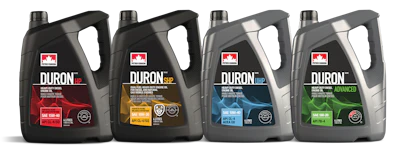
- Refreshed Product Lineup: The upgraded Duron portfolio spans four tiers—HP, SHP, UHP, and Advanced—introducing new options like the FB-4-certified 5W-20 for modern fuel-economy engines.
- Fleet Benefits: The new formulations are designed to lower total cost of ownership by extending asset and oil life, protecting exhaust aftertreatment systems, and reducing unplanned downtime.
A new American Petroleum Institute engine oil standard, PC-12, is slated to arrive in just a few weeks ahead of 2027 model-year emissions compliance.
During a media briefing Tuesday morning, Petro-Canada Lubricants, an HF Sinclair brand, announced the upcoming launch of its next-generation DURON heavy-duty engine oil line, engineered to help fleets maximize uptime, extend engine life, and reduce total operating costs. The new line is designed to exceed the performance requirements of the upcoming PC-12 specification and will be available starting Jan. 1, 2027.
The PC-12 specification, requested in 2021 to align with updated U.S. Environmental Protection Agency (EPA) and California Air Resources Board (CARB) rules, follows the trajectory established by previous categories like PC-10 and PC-11. It splits into two core categories: the fully backward-compatible CL-4 line and the FB-4 line, which supports lower viscosities to maximize fuel economy on newer engines.
"Compared with PC-11, PC-12 is designed to deliver three things," said Steve Krawiec, Petro-Canada Lubricants' Core Products Development Manager: "(1) enhanced wear protection to extend engine and asset life across the service interval; (2) optimized aftertreatment system protection so DPFs and SCRs will last longer; and (3) improved oxidation control, giving better oil stability supporting longer oil life and extended drain intervals, keeping engines performing at their optimum."
Performance benefits of the next generation of DURON include:
- Exceptional durability and wear protection: Supports longer engine life, delivering 50% better wear protection than the PC-12 requirement in the Caterpillar C13 test, twice the overall merit rating in the Cummins ISM test, and more than 500% better performance than the PC-12 requirement in the DD13 scuffing test.
- More than 50% better oxidation control: Achieves more than 50% better oxidation control than the PC-12 requirement after 300 hours in the OM471 Engine Cleanliness Test, giving fleets the potential to extend oil drain intervals and reduce downtime and operating costs.
- Improved aftertreatment system protection: Utilizes a lower-SAPS (sulphated ash, phosphorus, and sulphur) formulation to minimize ash accumulation in diesel particulate filters (DPFs) and other devices, reducing ash-related back pressure and supporting critical emission reduction and sustainability initiatives.
- Fuel efficiency savings: Helps unlock operating efficiency; industry research highlights that moving from an SAE 15W-40 to a 10W-30 can deliver fuel economy gains of up to 1%, with an additional 0.5% savings possible when transitioning from an API CL-4 to FB-4 engine oil (in line with OEM recommendations).
- Dependable cold-start and high-temperature protection: Developed for North America’s demanding environments, providing high-performance lubrication in temperatures as low as -40°C/-40°F alongside consistent oil degradation protection in extreme heat.
The refreshed Duron lineup is organized into four tiers:
- HP (High Performance): Synthetic blend 15W-40.
- SHP (Super High Performance): Synthetic blend 15W-40 and 10W-30 options, featuring natural gas engine suitability.
- UHP (Ultra High Performance): Full synthetic line offered across 10W-40, 10W-30, 5W-30, 5W-40, 0W-30, and 0W-40.
- Advanced: API F-category products, including 10W-30, 5W-30, and a new 5W-20 formulation targeted at modern fuel-economy engine platforms.
Avoiding missteps with PC-12 oil inventories
When PC-12 was initiated, the EPA's 2027 emissions regulations were set. Now that landscape has shifted, leaving the industry without a final rule just six weeks before PC-12's Jan. 1 launch.
As many engine manufacturers adopt a dual-engine strategy to navigate shifting regulatory and compliance timelines, fleet operators face a complex transition with the introduction of the PC-12 engine oil specification on Jan. 1, 2027.
Managing a mixed inventory of fully backward-compatible CL-4 formulations alongside restricted-backward-compatibility FB-4 formulations creates distinct operational hurdles, said Darryl Purificati, senior technical adviser for OEM/automotive for Petro-Canada Lubricants.
- Misapplication of oils: The single biggest risk on the shop floor is using the wrong oil in the wrong engine unit. Because FB-4 formulations are not universally backward-compatible in the same way CL-4 oils are, mixing up inventories can lead to severe compliance or performance errors. Not all OEMs qualify FB-4 where they previously recommended FA-4 oils, leaving specific platform-dependent requirements in place.
- Overlooking OEM recommendations: Fleets must avoid relying on blanket assumptions across mixed-generation engine models. Because some OEMs qualify FB-4 while others retain strict platform boundaries, failing to check specific OEM guidance for each vehicle type invites costly errors.
- Failing to leverage technical support: Navigating shop-floor inventories without expert guidance can result in improper product selection. Fleets should lean heavily on lubricant technical service advisors and strictly adhere to OEM recommendations to ensure the correct product is applied to the right equipment.
To successfully manage mixed inventories, Purificati advised maintenance supervisors to consult often with their lubricant providers, maintain rigorous education programs for shop personnel, and establish clear inventory segregation protocols to separate CL-4 and FB-4 products.