










Here's what you need to know
- American Trucking Associations President and CEO Chris Spear spoke to a Senate subcommittee on Tuesday.
- During the hearing, he urged senators to repeal the FET, work to make sure their getting trucking regulation right, and to establish a framework for autonomous vehicles.
- Spear also talked about underride guards and Chinese vehicles, components and software.
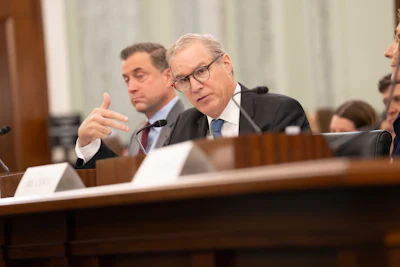
American Trucking Associations President and CEO Chris Spear told Congress on Tuesday that the federal excise tax was blocking necessary innovation in trucking.
Spear spoke to the Senate Committee on Commerce, Science and Transportation Subcommittee on Surface Transportation, Freight, Pipelines and Safety.
"The simplest and most straightforward Congressional action that will put safer, cleaner trucks on the road is the repeal of the onerous 12% federal excise tax (FET) on heavy duty trucks and trailers," Spear said. "This tax dates back to American entry into World War I and has grown to become a major disincentive — if not an outright financial barrier — to investments in new equipment."
[RELATED: New ATD President David Bell shares top priorities, goals for 2026]
The FET adds about $24,000 to the price of a new truck and more than $6,500 to the price of a new trailer, Spear said. And that cost could cause fleets to defer upgrading their equipment to safer, cleaner models.
Underride protection
Spear also told the Senate subcommittee that the ATA supports cleaning up federal data related to truck safety, including data on underride crashes.
"ATA's position has consistently been that decisions regarding additional underride guard requirements should be based on demonstrated safety benefits supported by comprehensive real world data," Spear said.
[RELATED: Bill introduced in Congress to require side underride guards]
Furthermore, the National Highway Transportation Administration (NHTSA) should continue to be the arbiter of trucking safety, Spear urged. This means states should not get to impose liability for failing to equip motor vehicles beyond federal standards.
"This invites legal uncertainty, undermines Congressional intent to empower NHTSA to promulgate nationally uniform motor vehicle safety standards and threatens supply chain integrity," Spear said. "Given that the trucking industry operates in all 50 states and that the market for motor vehicles is national in scope, we strongly support NHTSA's role as the primary authority over motor vehicle safety standards."

Deregulation efforts
Spear also praised the administration of President Donald J. Trump's efforts to pare down regulations on industry's such as trucking, such as removing rear underride guard certification label mandates and legacy trailer marking rules.
"While ATA supports regulatory reform, we strongly urge Congress and DOT to preserve proven, safety-enhancing regulations that would have negative material consequences on the safety of all road users if eliminated," Spear said. He cited as examples the electronic logging device (ELD) mandate as an example.
Autonomous trucks
Autonomous vehicles offer tremendous opportunities in trucking, Spear told the subcommittee, saying the technology would help make the industry more attractive for younger generations.
[RELATED: Autonomous trucks offer new opportunities for revenue]
"Autonomous technologies exist on a wide spectrum," Spear said. "Gradual integration of automated systems into the driving profession will mean an evolution — not an elimination — of the job and will almost certainly boost both safety and operational productivity."
The organization believes autonomous trucks will improve efficiency and give drivers flexibility to choose their preferred routes, Spear said, and it supports creating a framework for autonomous vehicle development and operation.
"We encourage Congress and federal agencies to continue developing proactive policies at every opportunity to foster innovation and ensure American leadership in the development of this important technology," Spear said.
China
Another issue the ATA supports is protecting American manufacturers and the industry as a whole from potentially unsafe vehicles, components and connected vehicle software from China, Spear said. He applauded the Connected Vehicle Security Act of 2026, which would ban the import, sale and operations of vehicles made in China and ban the use of connected vehicle technology developed in the country.
[RELATED: Commerce preliminary report: China, Mexico unfairly subsidize trailers]
"As commercial vehicles become increasingly reliant on telematics, fleet management systems, safety technologies and over-the-air software updates, it is important to ensure that foreign adversaries cannot exploit these systems to gain access to operational data or critical vehicle functions," Spear told the subcommittee. "Any restrictions affecting commercial vehicles should be implemented through a deliberate, risk-based approach that recognizes the complexity of trucking supply chains, avoids unnecessary disruptions to fleets and manufacturers that create operational or safety compliance challenges, and provides sufficient time for industry stakeholders to transition away from identified security risks."