











Preliminary August truck order data shows market preparing for model year change
- August orders: Class 8 units fell against July but were up 30-40% year over year, ACT Research and FTR report.
- Capacity constraints: Most 2026 surcharge-free engine build slots now full; 2026 backlogs oversubscribed by 35,000 units.
- Compliance costs will influence MY2027 orders: Noncompliance penalty engines add $6,000-$7,000; fully compliant EPA 2027 engines cost $8,000-$12,000.
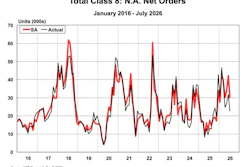
The 2026 truck order season came to an unremarkable end in August, with FTR reporting Wednesday preliminary Class 8 orders of 18,200 units in the month, down 19% from July but 42% stronger than 2025.
ACT Research estimated the month even weaker at 16,800 units, down 35% against July but up 31% year over year on easy tariff and carrier profitability comps.
FTR says the month-over-month decline largely reflects normal summer seasonality at the end of the order season, as well as the tail end of the EPA 2027 NOx pre-buy. The company states it is possible some OEMs’ 2026 order boards were sold out by early to mid-August, while 2027 order boards had not yet opened. The company believes most if not all surcharge-free MY 2026 engine build slots are now likely full, suggesting that the pre-buy is largely over.
ACT offers a similar assessment, noting weak orders do not necessarily mean weak demand. Rather, orders are running into oversubscribed 2026 backlogs and the corresponding 2026 build slot availability. To emphasize the point, the company says July ending data showed second half 2026 backlogs oversubscribed by 35,000 units, and also notes weak seasonality is a factor this month, as orders are typically slow in August just before OEMs open next year’s order boards in September.
“Overall, August marks the close of the 2026 order season and the effective end of the EPA 2027 NOx pre-buy,” says Dan Moyer, FTR senior analyst, commercial vehicles. “September begins a new phase with MY 2027 ordering opening and fleet decisions increasingly shaped by engine choice, pricing, build timing and the yet-to-be-finalized EPA 2027 NOx compliance framework.”
Through August, FTR reports orders in 2026 were up 111% from the same period in 2025. Orders during the 2026 order season (September 2025 through August 2026) were 39% above the prior-year period. Orders totaled 350,677 units over the past 12 months, the company says.
“Demand for new equipment remains strong, supported by meaningfully improved freight rates,” says Carter Vieth, research analyst at ACT Research. “While largely driven by severe contractions in the driver supply earlier this year, the Montgomery SCOTUS decision, stricter ELD/HOS rule enforcement and new carrier registration rules have also added to supply constraints and rate improvement through 2026.

He adds, “Despite freight volume headwinds driven by weakness in housing and K-shaped consumer spending, the recovery in U.S. manufacturing and the datacenter/utility buildout are marginally aiding the demand side of the freight equation. Q2 earnings from the publicly traded group of truckload carriers highlight the fleets’ profitability recovery, with aggregate net profit margins hitting a nearly-three-year high in Q2.”
[RELATED: Stakeholders share mixed feedback on EPA 2027 emissions rule adjustments]
With the 2026 order season now complete, attention is shifting to backlog execution, MY 2027 pricing and build slotting and fleets’ response to the choice between noncompliance penalty (NCP)-supported current-generation engines and fully compliant EPA 2027 technology.
FTR reports the now-complete EPA 2027 NOx pre-buy has been an important support for Class 8 demand, though EPA’s proposed flexibility should reduce transition risk.
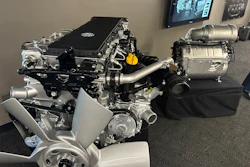
NCPs could add roughly $6,000 to $7,000 per engine, likely as a direct pass-through to fleets. In comparison, a fully compliant MY 2027 engine will carry an estimated $8,000 to $12,000 OEM upcharge.
“The main issue now is incremental cost,” says Moyer. “OEM strategies are diverging as some have decided to offer both EPA 2027-compliant engines and current-technology engines with NCPs while at least one manufacturer plans to offer only a fully compliant option. However, it’s important to keep in mind that EPA’s July proposal is just that. Various provisions, including NCP levels, could still change, affecting the final 2027 NOx compliance framework and associated cost impacts.”

The medium-duty market had a similar August. ACT reports preliminary Classes 5-7 orders rose 37% year over year to 20,000, seasonally adjusted to 20,500 units. On a seasonally adjusted basis, medium-duty orders have remained north of 20,000-unit levels the past four months, the company says, a marked improvement from the 16,000-unit order trend at the beginning of 2026.
The company adds the timing of the order improvement suggests customers and dealers are working to get ahead of 2027 regulations, but the U.S.’s ongoing economic resilience, despite inflationary headwinds, is likely another factor supporting higher order levels.