










Here's what you need to know:
- Federal prosecutors asked a U.S. bankruptcy judge to issue a stay, which was granted, in discovery in several of the civil cases related to the First Brands collapse.
- In the filing, prosecutors reveal details of the wrongdoing it alleges executives perpetrated, causing the company's collapse and the loss of thousands of jobs.
- First Brands is also exploring sale options for some of its lines of business, while it says others must be liquidated.
As First Brands gobbled up aftermarket brands and grew into one of the world’s largest auto parts companies with more than $5 billion in annual sales, executives and brothers Patrick and Edward James were orchestrating massive fraud and socking away the proceeds for themselves, federal prosecutors say.
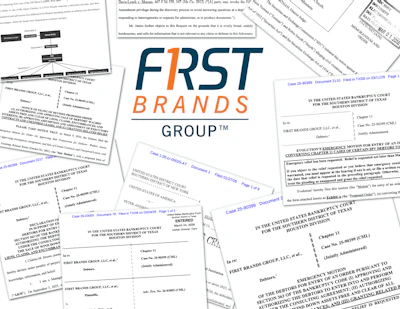
In a spate of recent court filings, U.S. attorneys detail the case against the James brothers and reveal First Brands’ catastrophic downfall.
U.S. motion for discovery stay, March 23
Prosecutors in the federal case requested a stay in discovery in several cases before the bankruptcy court in Houston on Monday.
Judge Christopher Lopez granted a stay Tuesday for 60 days. Lopez is the judge hearing the Chapter 11 bankruptcy case and overseeing several adversary cases in which First Brands is suing some of its financers and the James brothers. Adversary cases are similar to lawsuits in bankruptcy court.
U.S. attorneys say discovery in the civil cases would allow the James brothers, who were indicted in January, to “exploit the Federal Rules of Bankruptcy Procedure and the civil discovery process to circumvent discovery limits imposed by the Federal Rules of Criminal Procedure.” They argue the criminal case will resolve many issues in the adversary cases, including clarifying the James’ roles in First Brands’ collapse.
“As part of the defendants’ schemes, First Brands: faked and falsely inflated invoices for accounts receivable and payable; double- and triple-pledged load collateral; falsified corporate financial statements; and concealed substantial liabilities from lenders,” the motion, filed March 23, says. “These schemes yielded billions of dollars in financing necessary to fuel First Brands’ growth-through-acquisition strategy.”
Before it declared bankruptcy in September, First Brands amassed more than 20 auto parts brands, including Luber-Finer, Fram, Autolite, Cardone and others. Many of these brands have been shuttered in the wake of the filing and thousands of employees have been laid off. Walbro was sold for $50 million earlier this month, and filings say First Brands is exploring the sale of more of its lines of business.

Sale of assets
On the same day prosecutors’ request for a stay in discovery was filed, First Brands asked the court to approve the hiring of a consultant to help with the sale and liquidation of some of its North American businesses, including all of Brake Parts Inc., CWD, International Brake Industries, Foundry, Cardone, Autolite Operations and Hopkins Manufacturing Corporation.
“Although the Debtors [First Brands] are continuing discussions with potential bidders with respect to certain business units, the Debtors and their advisors have determined there is no viable path forward, either by sale or additional funding, to maintain the operations of certain North American business units,” the motion reads.
Motion expands on the indictment’s allegations
Prosecutors say even as First Brands spiraled toward bankruptcy, the James brothers continued to enrich themselves.
“Patrick James caused billions of dollars in gross proceeds to flow into First Brands from counterparties and received at least hundreds of millions of dollars in gross proceeds into his personal accounts,” the filing says. It goes on to allege Patrick James, at least, has sought to skirt federal rules governing criminal discovery and gain a preview of the government’s evidence against him, issuing at least 34 subpoenas in the civil matter, mostly to entities that are victims or witnesses in the criminal case.
“Absent a stay of discovery [the James brothers’ legal teams] will likely continue to exploit civil procedural and discovery rules to circumvent the careful limits on criminal discovery in the Federal Rules of Criminal Procedure designed to prevent, among other things, perjury and witness intimidation,” the motion says, adding witnesses and defendants such as Stephen Graham and Peter Andrew Brumbergs, both of whom have plead guilty and are cooperating with investigators, may be forced to choose between jeopardizing their criminal defenses and strategies or invoking Fifth Amendment rights and suffering adverse inferences in the civil proceedings.
Indictment alleges billions in fraud
In an attached sealed indictment, federal prosecutors detail the crimes it says the James brothers committed.
Patrick James founded the company in 2013, serving as its CEO. Edward James was the senior vice president. The government says from at least 2018 until the bankruptcy filing in September, the brothers faked and falsely inflated invoices for accounts receivable and payable; double- and triple-pledged loan collateral; falsified corporate financial statements and hid liabilities from lenders. The whole time, it says, the James’ raked millions into personal accounts.
By the time of its bankruptcy, First Brands reported $5 billion in sales globally but had just $12 million in cash and more than $9 billion in liabilities.
First Brands and the James brothers amassed those liabilities in several ways. The first was through factoring. Factoring is a financing arrangement in which a business sells or assigns accounts receivable to a third party, usually a bank or financing company, in exchange for near-term cash. That third party — a factor — collects full payment when the invoices become due.
The company used customer-linked factoring. Once a customer verified and approved an invoice from First Brands, a bank or financing company affiliated with the customer paid First Brands on behalf of the customer. When the customer’s invoice came due, it then paid the bank or financing company. In some cases, First Brands sold invoices to companies not affiliated with any customer. Those invoices were not verified and, prosecutors say, were sometimes falsified.
And First Brands used supply-chain financing, in which banks or financing companies advanced funds against invoices First Brands owed to its suppliers. The financer paid suppliers directly at a discount and First Brands repaid the financer later. Lastly, it also borrowed billions secured by physical assets such as its manufacturing plants and equipment, investigators alleged.
[RELATED: Jeffries Financial Group sued over First Brands exposure]
These complex and mounting financial arrangements left First Brands “vulnerable to cash-flow disruptions, sensitive to changes in collateral values and dependent upon continued access to external financing,” the indictment says.
Prosecutors gave specific examples of the misconduct they allege.
“In approximately 2023, one of First Brands’ third-party factors (‘Factor-1’) contacted First Brands seeking information about certain invoices that Factor-1 had purchased,” the indictment says. “When a lower-level First Brands employee provided the requested invoices to Factor-1, Factor-1’s audit partner began questioning Edward James, the defendant, and others about what the audit partner described as ‘huge’ discrepancies between the amounts reflected on the First Brands invoices and the information about those same invoices that First Brands had previously provided to Factor-1.”
After the incident in which prosecutors say the actual invoices were provided instead of fraudulent ones, Patrick James directed emails from parties including Factor-1 be restricted to one of the company’s executives.
In June, First Brands invoiced a customer for $8,976.24 in automotive parts. Prosecutors say it sold that invoice to Factor-1 claiming it was $17,826.26 and, three days later, sold the same invoice to another factor, claiming it was for $463,734.92. By the time of the bankruptcy, U.S attorneys say factors held $2.7 billion in fake accounts receivable from First Brands.
‘Round-trip’ financing
The James brothers not only faked the invoices and information about First Brands’ financial position, prosecutors say, they also had financers send money to a third-party bill processing company. Financers thought the money was going to pay suppliers, but instead, the indictment says the money was routed to First Brands itself in what the James brothers and other employees in on the alleged fraud called a round trip.
“Their purpose was to inject additional cash into First Brands at moments when the company was unable to meet its payment obligations with legitimate cash on hand,” the indictment says. “Rather than paying suppliers, ‘round trip’ funds went toward paying interest in debt, rent, leases or other operating costs.”
First Brands’ internal records tracked available borrowing capacity, net cash flow and the impact of these round-trip payments. Prosecutors say the James brothers and other executives regularly discussed the scale, timing and necessity of round-trip payments to manage short-term liquidity, with one executive saying in 2021 it was “getting out of control.”
Hidden off-balance-sheet debt
Prosecutors say the James brothers hid the growing piles of debt from the company’s lenders by using companies that had no independent business operations but were owned and controlled by Patrick James, what they call the James Entities. It says three lenders advanced funds to these entities, which then used the money to purchase inventory from First Brands, selling it to off-sheet lenders, and then leasing the inventory to the James Entities, funneling the cash to First Brands.
For example, in July, a lender sent First Brands a diligence request. In its reply, one of First Brands’ senior executives said the company had “no off-balance sheet financing” involving “special purpose entities” and “all related party relationships” were disclosed in the company’s financial statements. At the time, First Brands had $2 billion in off-balance-sheet debt, the indictment says.
Where’d the money go?
The indictment says some of the money went to First Brands, but millions more went into personal accounts owned by one of the James brothers. In one adversary case, First Brands Group v. Patrick James, et al., First Brands says Patrick James “secretly pilfered some of the Company’s assets to fund his and his family’s lavish lifestyle.” This includes a collection of homes and exotic cars, $2 million in payroll for a family office, $3 million for rent of a New York City townhouse, $500,000 for a private celebrity chef, $150,000 for a personal trainer, and $110,000 for a six-week hotel stay.
The same suit says transfers to Patrick James’ personal accounts occurred suspiciously close to James’ acquisition of a home in Malibu in 2019 and another home in the Hamptons in 2021.
In countering motions, Patrick James defends his actions.
“The Debtors [First Brands] … appear focused on creating sensationalist headlines regarding one-sided monetary transfers without acknowledging the substantial transfers into First Brands Group from Mr. James and affiliated entities,” one motion, filed Nov. 4, reads, calling the accusations about Patrick James’ spending a “specter of ‘misappropriation’ and fraudulent transfers.”
What’s next?
Discovery in the adversary cases is temporarily halted. The criminal case against Patrick and Edward James is “proceeding expeditiously,” the U.S. Attorney’s Office in the Southern District of New York says. Trial is set to begin July 13. For Brumbergs and Graham, who have already plead guilty, their sentencing will take place after the James trial concludes. Both proceedings are before Judge Analisa Torres.
In bankruptcy court in Houston before Judge Christopher Lopez, First Brands and its creditors are working with a mediator to sort out claims. Several adversary suits are pending before Lopez as well. So far, more than 13,000 claims have been filed, some for as much as $4,706,592,257.03 (Wilmington Savings Fund Society, Wilmington, Del.). As of press time, the next hearing before Judge Lopez is April 2.