










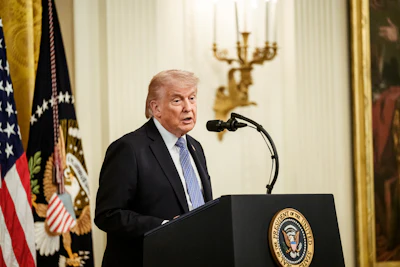
A U.S. trade court ruled last week that President Donald J. Trump’s 10% global tariffs imposed under Section 122 of the Trade Act of 1974 are unlawful, but only for the two businesses and the state of Washington named in the suit.
The three-judge panel found the tariffs were unlawful and harmful to businesses. This follows a February Supreme Court ruling that struck down Trump’s tariffs imposed under the International Emergency Economic Powers Act (IEEPA). The government now owes importers around $175 billion in tariff refunds, plus interest.
“Given the narrow nature of the (Court of International Trade’s) ruling and the fact that the Section 122 tariffs are due to expire at the end of July anyway, none of this has any immediate implication for the U.S. tariff rate,” says Stephen Brown in a Capital Economics research note.
What the ruling does do, Brown says, is open up the risk the federal government may be liable for more tariff refunds in the future. If companies other than the two firms — a spice importer and a toy company — and the state of Washington want to be exempt from the tariffs, they must also file suit. But Brown says more companies are unlikely to do so just now.
“Others will first wait for this ruling to be appealed by the Trump administration, which means it could follow in the footsteps of the IEEPA tariffs by going through the Court of Appeals and potentially up to the Supreme Court,” Brown writes.
The Trump administration says it will appeal the ruling. U.S. Trade Representative Jamieson Greer says the administration expects it will prevail.
“They essentially said that Congress passed a law that can’t be used, which we all know in the legal community that’s not how the law should be interpreted,” Greer told Fox News. “So we’re confident that on appeal we’ll be successful.”
Greer’s office is also pursuing Section 301 investigations. This section of the Trade Act of 1974 allows the U.S. Trade Representative to retaliate against countries engaging in unfair trade practices after an investigation. So far, Greer’s office seems to be looking into China, the European Union, Singapore, Switzerland, Norway, Indonesia, Malaysia, Cambodia, Thailand, South Korea, Vietnam, Taiwan, Bangladesh, Mexico, Japan and India.
Mexico is notable because the country supplies over 40% of all auto parts imported by the U.S., including heavy duty truck parts. Mexico trades with the U.S. under the United States-Mexico-Canada Agreement, which is in the early stages of its regular review process. Right now, trucks with 64% of their value originating in North America are duty-free. That rises to 70% in 2027.
USMCA compliance also exempts trucks from a 25% tariff enacted under Section 232 of the Trade Expansion Act of 1962. These tariffs are not affected by the IEEPA or the Section 122 ruling.