











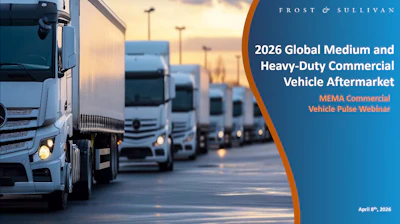
Global GDP outpaced aftermarket spend rates for commercial vehicles in 2025, but the year was strong enough to set a foundation for trucking to manage political volatility, tariffs and shifts in vehicle powertrain demand in the years ahead, Anuj Monga, global research manager of aftermarket mobility, automotive and transportation research at Frost & Sullivan, told attendees during a MEMA Pulse webinar Wednesday.
While acknowledging the tense geopolitical environment in which he was presenting Wednesday, Monja said there are many trends appearing across the globe and in North America that are planting seeds for growing aftermarket sales. The engine and transmission-heavy mechanical powertrain service work that defined the aftermarket in the past won’t be the focal point of its future, but Monja said that doesn’t mean the aftermarket is at risk.
Instead, he said Frost & Sullivan predicts aftermarket revenue streams are simply migrating, moving into newer categories and emerging solutions that suppliers and their distribution partners are still bringing to the market.
[RELATED: RigDig data shows U.S. carrier, equipment levels steadying]
As such, Monja said 2026 and the immediate years ahead could be table-setters. Vendors first to market and perfect the technologies that will define the future of the global aftermarket will “take the pole position for the years ahead,” he said.
What are those solutions? Frost & Sullivan defines its largest aftermarket trends as follows:

Monja said the continued shift toward uptime enables component sales but also telematics, prognostics and data analysis. Suppliers who can keep customers connected and informed about their system performances are already winning business from the world’s top carriers and as more of this technology is integrated into the fleet that will only continue.
Regarding OTA updates, Monja said the familiarity and acceptance of this technology in passenger vehicles assures its continued adoption. As for nearshoring, he said many global vendors have spent the last 12-plus months working to bring their sourcing, manufacturing and assembly plants closer to their markets. Trade debate, especially in the U.S., has tailed off recently due to the conflict in Iran, but Monja said the efforts being made by vendors now will lead to more resilient supply chains if and when the White House brings trade back into focus in the future.

As for adaptability and automation, Monja again cites the success of these solutions in the automotive and other industries as reasons to anticipate their permeation into global trucking and its aftermarket.
He said to today’s global carrier, “total cost of ownership is the metric that matters most,” and the guiding light fleets use when adopting technologies. He said aftermarket vendors should welcome this and continue investing in solutions that support the TCO focus.
As for the rest of 2026, Monja was moderately positive. He said Frost & Sullivan’s most recent annual forecast has commercial vehicle aftermarket spend rising by 3.5% per vehicle year over year, led by hotspots in North America and Asia-Pacific markets, and outpacing global GDP that is tracking around 3.0%.
[RELATED: Best parts lookup tools for heavy-duty truck parts]
Monja added the company’s estimates show the total number of commercial vehicles in operation to rise by 1.6% to 50.9 million, with aftermarket parts sales up more than 5.2% to $167 billion globally.
Within North America, the company expects GDP to rise from 2.0% to 2.4% in 2026, with aftermarket revenue jumping up from $36.46 billion to $38.56 billion. Monja added those numbers are built on the expectation medium- and heavy-duty sales deliveries slip a bit against 2025, increasing parts demand for an older fleet and factoring in moderate inflation in pricing due to the continued supply chain overhaul.