











Global truck manufacturers face higher development costs as regionality increases
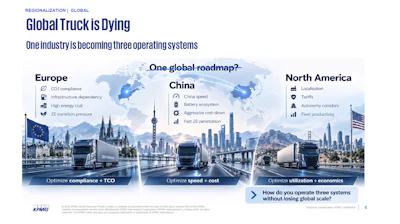
- Global OEMs must now develop separate truck designs for North America, Europe and China due to diverging powertrains and regional priorities.
- Chinese manufacturers like BYD gain competitive advantage by focusing solely on battery electric heavy-duty trucks rather than competing in the diesel market.
- North American OEMs are diversifying electrification investments into data centers, microgrids and energy services to maximize returns of battery technology investment.
Electrification, fuel-cell technologies and the growing capabilities of Chinese manufacturers led conversation at the global IAA Transportation Expo this week in Hannover, Germany, a notable divergence from the diesel-centricity that’s reemerged in North America in recent years, KPMG’s Marc Schmidt and David Royce told suppliers during the most recent MEMA Pulse webinar Thursday.
“It felt a bit like the ACT [Expo] from three or four years ago,” Royce told attendees of the IAA event, which concluded earlier in the day across the Atlantic. “It didn’t feel like it was aligned with what the U.S. has moved through over the last couple of years.”
The duo note that separation is notable because the global trends seen at IAA are still the responsibility of North American OEMs across their larger operations. Schmidt says until a few years ago, the concept of a global truck remained aspirational though not yet actionable. He says that’s no longer the case. The regionality of trucking across North America, Europe and China will force manufacturers who play across multiple markets to develop split (or duplicate) development and operational teams to bring the best vehicles to each market to meet in area.
Schmidt acknowledges much of the technology necessary for today’s modern trucks — particularly in the areas of advanced driver assistance systems (ADAS) — can be developed singularly and implemented globally, but diverging powertrains and power generation will increase cost.
[RELATED: McKinsey warns low-cost Chinese trucks will threaten Western OEMs]
This is an area where China’s singular focus on electrification is advantageous, the duo note. The Chinese are not attempting to compete in the internal combustion engine (ICE) diesel space — they aspire to build battery electric heavy-duty tractors. And while that might delay their entrance into North America, they are already elbowing their way into the European space. Royce says BYD’s booth at IAA was comparable to what was found across the expo with European OEMs, and Schmidt says he’s ridden in a BYD tractor and was “amazed by how well it drove.”

Coupled with their reduced costs, this will enable Chinese OEMs to immediately compete in Europe against the OEMs based there who are spending billions to develop EVs to meet the regulatory demand of the European Union.
KPMG’s research indicates European OEMs are in the early commercialization stage of their EV journey, with a goal of reaching scale between 2030 and 2035. They say 40% of the EU’s electric truck fleet was added last year, and increased acceptance does support investment in infrastructure.
[RELATED: Value lines are booming; what does that mean for the future of truck parts brands?]
Conversely, the willingness and funding to do the same in North America has evaporated during the second administration of President Donald Trump. KPMG’s duo says global OEMs with North American operations and domestic suppliers are shifting their R&D resources away from alternative power toward ADAS and autonomous solutions.
And full-scale implementation seems to be on a similar adoption curve as European EVs.
KPMG is projecting the rest of this decade will serve as a scaling up period for Aurora, Kodiak, OEMs and other autonomous trucking developers, with integrations into commercial logistics businesses coming in the first half of next decade. The duo note some regulation and nationwide driver acceptance of driverless Class 8 tractors are still hurdles the technology needs to pass, but doing so should be less expensive and time consuming as building a nationwide charging network.
There’s also the question of what domestic manufacturers should do with the investments they’ve made into electrification. Schmidt and Royce say many companies are expanding their solutions into adjacent markets, such as data centers, which increasingly require advanced cooling and resilient power systems, as well as microgrids, energy services and electrified ecosystems.
This way, if a singular global truck development process returns in the future OEMs will be capable of pivoting, but in the meantime these diversified efforts will allow for them to maximize the return on investment they’ve already made.