











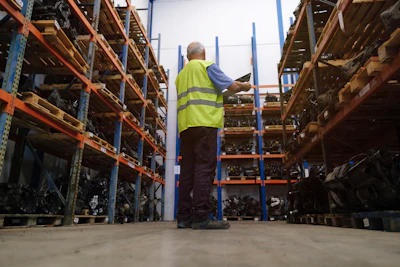
Many heavy-duty parts and service companies struggle with core management, often experiencing lost cores, missed credits, uncertain return timing and complex tracking requirements.
In fact, poor core tracking alone can cost operations tens of thousands of dollars annually through missed reimbursements and administrative inefficiencies.
In most cases, the answer is an enterprise resource planning (ERP) solution that is heavy-duty business focused — either by design or adaptation. Such ERP software tightly integrates critical business activities, sharing and correlating data across inventory, accounting, warehouse, sales and service functions.
When properly deployed, it can overcome core challenges with automation. This empowers heavy-duty parts and service companies, especially those serving the heavy-duty aftermarket, to compete more effectively.
[RELATED: New data shows trucking collisions are up, but severity levels have decreased]
Below are seven ways the automation offered by the right ERP solution can replace core management headaches with greater efficiency, profitability and operational control.
Providing clear visibility into core inventory
The challenge: The most prevalent problems in core management are attributed simply to not knowing where cores are and their value. Without accurate tracking, cores can easily be misplaced, discarded or forgotten.
[RELATED: Simple steps to increase profitability in parts department core management]
ERP fixes it by providing centralized visibility into all core-related transactions. Each core can be tracked from the moment the part is sold until the returned core is processed and credited. This real-time visibility allows companies to monitor core balances, identify outstanding returns and ensure no core value is lost.
The result is tighter inventory control and improved financial accuracy.
Avoiding missed vendor credits and core returns
The challenge: Many heavy-duty parts companies lose money because cores are not returned on time or fail to meet supplier requirements. Suppliers often have strict eligibility criteria and deadlines for core returns.

ERP fixes it by simplifying the return process with automatic tracking of core eligibility, due dates and supplier requirements. The system should alert users when cores must be returned and ensure all documentation is properly recorded.
This dramatically reduces missed credits and ensures businesses capture the full financial value of every core.
Optimizing customer core tracking
The challenge: Monitoring which customers owe cores is another common challenge. Without reliable systems, it becomes difficult to know which customers have outstanding core returns.
ERP fixes it by automatically linking core deposits to the original sales transaction and maintaining detailed customer core balances. Parts managers can instantly see which cores are outstanding and follow up with customers before deadlines expire.
This improves cash flow and reduces disputes with customers over deposits and returns.
Establishing certainty in core availability
The challenge: Remanufacturing depends on a steady supply of returned cores but predicting when and how many cores will be returned can be difficult. The timing, quantity and quality of returned cores are often uncertain.
ERP fixes it by helping companies manage this uncertainty with analytics and forecasting tools that track core return trends, supplier demand and inventory levels.
With better insight into core supply, companies can plan purchasing and inventory strategies more effectively and avoid costly shortages.
Streamlining identification and part matching
The challenge: Many cores exist in multiple versions, revisions or configurations. Identifying the correct core and matching it to the correct remanufactured part can be complicated and time-consuming.
ERP fixes it by simplifying this process with integrated part identification tools and automated validation checks. The system ensures that cores meet supplier acceptance criteria and match the correct part numbers.
This reduces errors, improves compliance with supplier programs and speeds up processing times.
Removing administrative burden and manual processes
The challenge: Without automation, core management often involves spreadsheets, paperwork and manual tracking. These processes increase the risk of errors and require significant staff time.
ERP fixes it by automating the entire core management workflow — from sales transactions and deposits to returns, credits and reporting. Automated reporting, dashboards and alerts allow parts managers to identify issues quickly and resolve them before becoming costly problems.
[RELATED: The overlooked work behind successful customer e-commerce adoption]
This reduces administrative workload while improving operational accuracy.
Tapping underutilized revenue opportunities
The challenge: Many companies treat cores as an afterthought rather than a strategic asset. Yet cores often carry significant value, sometimes hundreds or even thousands of dollars, depending on the component.
ERP fixes it by transforming core management into a profit center — providing full visibility into core value, recovery rates and credit opportunities.
With detailed reporting and financial tracking, companies can identify missed opportunities and maximize profitability from their remanufacturing programs.
Conclusion: Turning core management into a competitive advantage
Core management will always be a complex part of heavy-duty aftermarket operations. However, with the right technology, that complexity becomes manageable — and even profitable.
An ERP solution with integrated core management capabilities gives parts and service companies the tools they need to:
- Track cores accurately
- Recover more supplier credits
- Improve customer accountability
- Reduce administrative overhead
- Forecast core supply and demand
- Increase operational efficiency
- Realize the full financial value of every core
Instead of being a logistical headache, core management becomes a structured, automated and profitable business process.