











As a crown jewel of technical achievement and recognition across the dealer space, attending the annual Rush Skills Rodeo can be a landmark experience for technicians.
The Rodeo is unquestionably a party — a celebration of the hundreds of contestants and thousands of associates on the front lines of the Rush Truck Center network supporting the trucking industry each day — but it’s not exclusively one.
With more than a dozen competitive tracks across truck and trailer repair, parts sales, equipment sales and more, the Rodeo’s growing size and scope continues to make it the most comprehensive performance-based employee program in the industry.
Celebrating its 20th anniversary at the Gaylord Opryland in Nashville this week, the Rush Skills Rodeo continues to focus on creating the most stimulating, challenging and illuminating testing experiences for its participants. And it is intensive testing that makes the post-event celebration and recognition for participants so meaningful.

“There’s no prepping for it. That’s my personal experience,” says Yunis Abdul, technician at the Rush Truck Center – Richmond, Va., location. Participating at the rodeo for the second time after an initial trip in 2023, Abdul is competing this week in the Medium Duty category. He says back in Virginia he works on medium- and heavy-duty trucks alike, but this week his focus is on the former.
Since being informed he qualified for the Rodeo in October, Abdul says he’s tried to seek out medium-duty jobs and opportunities to hone his skills ahead of the competition but says there’s really no substitution for the real thing.
Jon Steckman agrees. Technician at Rush Truck Center – Columbus, Ohio, Steckman is competing at his 13th Rodeo in 2025 in the Heavy Duty category. He admits he’s more comfortable in the surroundings now than those initial trips, and has the hardware to show for it, but says the puzzles created by the supplier judges remain impressively unique each year.
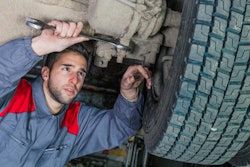
 A competitor works on a repair while a judge looks on during the 2025 Rush Tech Skills Rodeo in Nashville.
“There is not a great way to prepare for it other than being at the top of your game all the time,” he says. “I try my best to know the processes and procedures and take every job by the horns.”
Rush Enterprises Vice President of Service Operations Victor Cummings says that’s by design.
“The key is to articulate to the judge what you’re doing, why you’re doing it. And make sure you follow the OE diagnostic troubleshooting steps,” he says. “Sometimes the techs will come here and test and they’ll think they know — or even do know — what the issue is, but they’ll bypass a lot of the required steps to validate the true cause of failure.”
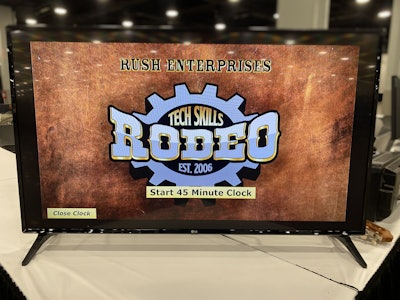
Another tough variable of the Rodeo is the time component. Hands-on diagnostic and service testing segments are only 45 minutes long. Cummings says judges are intentional about creating problems technicians following OE service guidelines should be able to diagnose and solve in that time period but with little time to spare.
“There aren’t a lot of technicians who finish the testing with ample leftover time. It’s rare,” he says.
The technicians state that brings the ticking clock into one’s headspace.
“The time limit is always on your mind,” Steckman says. “You never want to miss something.”
The structure and setting creates its own mind games too, Abdul says.
“What puts the pressure on is when a truck comes in the shop, you don’t know if it’s something simple or something crazy but here you know it’s something crazy,” he says. “You can kind of back off because you’ll want to do something, and then you’ll back off because you’ll think ‘They wouldn’t go that deep,’” he says. “You start to second guess yourself.”
“I know my multimeter like the back of my hand,” adds Steckman. “So when I get here and am given a multimeter that’s different than what I’m used to, that can be a hiccup.”
The best way to manage the environment is sticking to the book.
[RELATED: How Hendrickson positions itself as trucking’s ride control leader]
“As much as you want to, in the real world you can kind of get away from the step-based diagnostics,” says Steckman. “You don’t want to, but there are those distractions. But here, that’s how you get your points. Sometimes guys that are great at what they do. If they miss one little step, at [a competition] like this, that can make or break you.”
But the stressful experience doesn’t come without its reward.
Beyond the gifts, monetary prizes and trips awarded to top performers, all technicians attend a debrief after their testing concludes in which the judges and test developers share with the contestants how repair should have been completed, to ensure all head home with the knowledge necessary to manage it in the field and share with their colleagues.
“It’s really helpful, because there’s also a lot that you can ask them,” says Abdul.
 A competitor works on a repair while a judge looks on during the 2025 Rush Tech Skills Rodeo in Nashville.