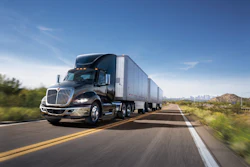













Introduced in 1926, Hendrickson’s walking beam architecture has remained in continuous use for a century wherever trucks must carry significant weight across uneven terrain.
The company traces its walking beam technology to the original suspension design developed by company founder Magnus Hendrickson in 1926 and has continued to refine that equalizing beam concept across several modern configurations. The RT suspension remains closest to the original architecture, while HAULMAAX EX and ULTIMAAX apply elastomer and progressive spring technologies to support on‑ and off‑highway vocational applications ranging from refuse and concrete to mining and oil field work, the company says.
Modern vocational vehicles require stability and off‑road mobility while also managing driver comfort, vehicle weight and the protection of increasingly sensitive hydraulic, electronic and body equipment from continuous vibration. Hendrickson states it has evolved its walking beam‑based suspensions around these needs, incorporating fabricated structures and higher strength steels to reduce weight and accommodate different beam lengths, capacities and vehicle configurations. Spring technology has advanced alongside the beam, with elastomer load springs and progressive designs tuned to deliver a smoother, more controlled ride while preserving the stability demanded in severe‑duty environments, the company says.

- Traction and load equalization across uneven terrain as axles articulate, helping maintain tire contact and share loads between axles.
- Ride and vibration control, as modern rubber and progressive springs screen out road inputs that would otherwise reach the cab, body, and mounted equipment.
- Payload and weight efficiency, with lighter fabricated components contributing to additional payload in weight‑sensitive applications such as refuse, concrete, and aggregate hauling.
- Application‑specific configurability through different spring types and suspension layouts tailored to load capacity, terrain, chassis packaging, and maintenance priorities.
After 100 years, Hendrickson says the walking beam no longer represents a single fixed design but an engineering foundation that continues to be adapted to new materials, powertrain options and operating demands.
“As vocational trucks evolve and fleets focus more closely on total cost of ownership, Hendrickson’s walking beam‑based suspensions remain centered on matching the suspension to the work the vehicle performs and ensuring that components around the beam are designed, validated and supported to perform dependably over the long term,” the company says.