











The wrong engine spec can kill a customer’s productivity. And if you helped them spec it, it can also be a dent in your relationship.
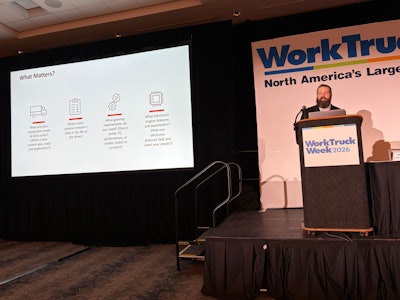
During an educational session Tuesday at Work Truck Week 2026 in Indianapolis, Cummins’ Kris Ptasznik and Obed Ruiz shared vital keys for how to properly spec a powertrain for work truck applications — offering guidance on what matters most, how customers, OEMs and dealers can work together to make smart decisions and common mistakes that lead to bad spec’s, bad performance and soured relationships.
“The No. 1 thing I need to know is about your operation,” says Ptasznik, Cummins’ Engine Business powertrain TCO and consultancy leader. “Is it one-size-fits-all? Do we need multiple applications? What’s a day in the life of your driver?”
He says those questions are just examples of the many he asks any customer needing to spec new equipment. Before ordering anything, a customer needs to know what matters most to their business, Ptasznik says — productivity vs. payload, as an example — and be willing to make compromises.
[RELATED: Daimler adds three Cummins engines to 2027 lineup]
“You can’t have fuel economy and performance. I know everybody wants that, but you’ve got to make sacrifices,” he says.
Ptasznik says in these early conversations, customer transparency is vital. He uses payload requirements as an example. He says far too often a customer will claim their equipment must be able to haul an extreme weight, like 260,000 lb., but in reality they may only haul that weight once every few months, with most loads under 200,000 lb. Ptasznik says in those situations he may advise the customer to choose a powertrain better suited to the lighter weight because that’s the application they’ll see most often. But ultimately, it’s the customer’s choice.
“[If] once every three months the driver will say it doesn’t pull as good. Is that acceptable?” he asks.
Customers also must share their ownership cycle plans and current vehicle performance data. How much a customer expects to receive when selling a unit into the secondary market should be addressed before their order is placed, as should maintenance intervals, service capabilities and current specifications.
Ptasznik says sometimes customers will be loyal to a spec but be unaware of a superior new product, or that a recent adjustment to their current spec may impact its future performance. Or, they’ll complain about their current spec but let aforementioned extreme requirements influence their needs instead of optimizing their spec for their most consistent application.

And this is where Cummins’ expertise is essential, Cummins’ duo adds.
Ruiz, Cummins’ Engine Business general manager – vocational business, says the powertrains Cummins are developing to meet EPA 2027 regulations have different horsepower and torque ratings than the company’s current product line, which means some customers may have several options to potentially meet their needs.
 A chart showing performance capabilities of Cummins' current and future powertrain options.
Ptasznik also advises customers work with their dealer to use Cummins’ Powerspec comparison tool to test powertrain options and determine their best choice. He says Powerspec is a great way for uncertain customers to uncover what really matters most, whether its fuel economy, driver comfort, payload or something else.
The goal, Ptasznik says, is for Cummins to make sure their customer always makes the best choice. “What do you have, what are you trying to do, how can we get you there?”