











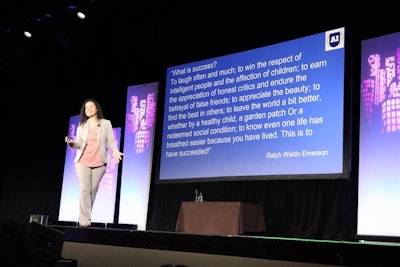
Noelle Russell took the stage at last week at Heavy Duty Aftermarket Week 2026 (HDAW) in Grapevine, Texas, at least as first, as a deep fake to introduce herself. Nearly Noelle, as she called her, brought the very real Noelle on stage. It was nearly impossible to tell the difference between the video and Noelle herself.
For most of us, Nearly Noelle and her compatriots on social media, e-commerce sites and more are how we interact with artificial intelligence (AI). Maybe we’ve used it to touch up our family photo for a Christmas card or add a cute background on our virtual meetings. Or we’ve asked it to check inventory or put the fine points on an email.
HDAW and the day before at Heavy Duty Aftermarket Dialogue (HDAD), showed AI can do much, much more if it’s properly managed and strategically executed. But a startlingly few businesses are executing it a way that builds a return on their investments.
[RELATED: Procede shares its AI journey, and the potential it offers users]
Aakash Arora and Nathan Niese of Boston Consulting Group (BCG) told HDAD attendees only one in seven commercial vehicle aftermarket players are realizing value from AI investments today. That’s not to say they aren’t using it. The overwhelming majority — 70% — of respondents to BCG’s survey said they are investing in AI. But only 14% have seen value delivery from their investments.
The difference, Russell says, could be not in the technology, but the people. You have to build what people want, she says.
“As you begin to get excited (hopefully) about artificial intelligence, someone in your organization is going to be me, going, ‘Do you think we can do this one little thing,’” Russell says. And you might not be sure it’s the right thing. “I’m going to encourage you to really understand who you are as an organization. Your core values, who you are as an individual. Those core values will tell you what people want.”
[RELATED: AI reshaping customer search, e-commerce interaction landscape]
BCG says, at a high level, there are three core challenges facing the aftermarket: controlling cost and margin pressure, improving forecast accuracy and predictability, and increasing service quality and reliability. That’s not a bad place to start understanding what people want.

Digging deeper, BCG’s survey showed the highest value comes from AI use cases such as dynamic pricing and cost modeling, demand forecasting and inventory optimization, and parts and cross-reference automation. Coming back to people, these are all tasks machines can do quickly and efficiently, with some human help, to free up those people to do more of what people do best — relating to other people. There’s the value: Leveraging AI to do what it’s good at to allow people to do what they’re good it.
But there’s a catch. AI makes these tasks so easy it’s tempting to follow Nearly Noelle into the ether and push the technology into areas it’s not yet ready for. Russell says to treat the technology like a baby tiger. It’s cute, it’s cuddly, it does neat tricks, but it’s got awfully big paws and sharp teeth. With poor management, AI can grow into a beast that will eat margins and your workforce for breakfast.
“Be careful with this stuff,” says Russell, who was a lead developer at Amazon in the creation of Alexa and has worked in AI development throughout her career. “When you adopt an AI model, you’ve got a little baby tiger in your midst. It’s called the hype cycle. All good AI has to go through this phase. It has to start this way, or you won’t use it. It has to start cute, meaningful, useful, value driven. What no one likes to ask in this super-cute phase is … how big are you going to be?”
The middle ground in the cycle is a yawning pit many aftermarket businesses are falling into. Take this statistic from the BCG study: Half (53%) of companies are somewhat confident or very confident they will be scaling AI over the next three years. But only a quarter (26%) are clear or very clear on how they’ll use it.
That disconnect is one big reason a lot of AI initiatives fail. Russell says 95% of AI pilots fail. The 5% that succeeds, she says, have some things in common, including well-trained models with strategic prompts to optimize processes from an ethical foundation that builds trust. And it can come from within.
“We have more power now than ever,” she says. “Now is the chance. We have the opportunity to use our words to build systems that help us remove friction from every part of our organization’s experience. With great power comes great responsibility. … Today is the day. Build a strategy. The AI people that will change your business already work for you. All you have to do is give them a little bit of space. We call that innovation.”
AI is a complicated space, as Nearly Noelle and BCG’s statistics prove, and it can feel like a house of mirrors. But the use case is there. The innovation is there. For companies with a strategy, a plan, and with clear decision making grounded in their core values, it’s time to tap in.