










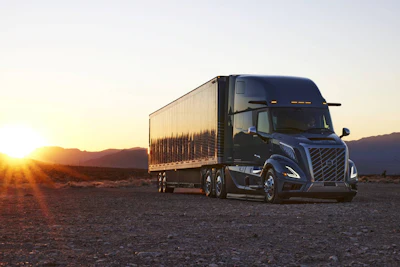
Volvo Trucks second quarter earnings highlights
- North American orders jumped 122% year over year in Q2 2026, with total net orders up 33% and deliveries up 6%
- The company achieved highest profitability in recent quarters despite $124.32 million in tariff costs and a $196.5 million CARB settlement
- Mack Trucks' market share grew to 8.4% with 93% more orders, though deliveries fell 14% due to production constraints
Volvo Group, parent company of Volvo Trucks and Mack, reported a 122% jump in North American orders in the second quarter of the year. The company attributes the spike to freight volume and rate increases in the United States combined with higher fleet age.
"The second quarter of 2026 demonstrates the strength and adaptability of Volvo Group," says Martin Lundstedt, president and CEO. "Profitability reached its highest level in recent quarters. ... This improvement was achieved despite headwinds from net U.S. tariff costs as well as higher freight and material costs. These were more than offset by a stronger service business, a favorable brand and market mix as well as lower net R&D expenses."
Retail sales not as robust
The demand has not, however, been reflected in retail sales. Volvo says those were 18% lower year over year, but are expected to rise along with truck production and deliveries.
[RELATED: Volvo Trucks enables software updates without interrupting operation]
Total truck sales were $9 billion in the second quarter, up 7% year over year. Total net orders were up 33% year over year and deliveries were up 6%. Mack Trucks saw its market share grow to 8.4%, with 93% more orders year over year but 14% fewer deliveries in the quarter.
Volvo Financial Services stays stable
Volvo Financial Services' portfolio was up 1% year over year in the second quarter, with an increase in delinquencies and write-offs from the previous year.
"For Volvo Financial Services, the portfolio performance continued to be good although credit provision expenses were slightly higher than in Q2 2025," Lundstedt says.
Negative impacts of CARB settlement
The quarters financial statements did see a negative impact of $196.5 million due to the settlement with California's Air Resources Board (CARB). In resolving allegations emissions controls on some Volvo trucks sold in California were inadequate, Volvo will pay $12.5 million in civil penalties, $71 million to CARB's Air Pollution Control Fund, $108 million on California emissions reduction projects, and reimburse $5 million of CARB's costs.
Volvo says the payments were excluded from adjusted operating income.

Tariff impacts
Tariffs took $124.32 million out of the company's bottom line, but Volvo expects third quarter tariff expenses to be offset by a refund it filed to recoup costs of levies struck down by the Supreme Court. In the third quarter, Volvo expects tariffs to cost the company $113.69 million, but that should be offset by the expected refund.
"Recent tariffs and other trade restrictions imposed or considered to be imposed by the U.S. and other countries have significantly increased uncertainty about trade conditions in markets where the Group is present, as well as in relation to global and regional supply chains," a Q2 report says. "The situation is fast-changing and complex to assess, and future developments remain uncertain, including whether trade restrictions may impact the group more severely than its main competitors."
Supply chains
Volvo continues to monitor global supply chains, which it says are strained in some areas from shortages of labor, materials and components, transport services and more.
"Further strains on the supply chain may also evolve from other events, including financial distress of suppliers, introduction of new or amended export controls, tariffs or other restrictions on international trade, ongoing conflicts in the Middle East and other geopolitical events," the quarterly report says. "There might be supply chain disturbances and stoppages in production going forward. Such disturbances could lead to higher costs and interruptions in production and delivery ... ."
Other developments
Volvo is also watching macro and market developments, the company says, including instability in the Middle East, energy costs and more.
"Looking ahead, we remain watchful and responsive to geopolitical developments, trade policy shifts and the speed of transition into zero-emissions transport," Lundstedt says. "We are gradually offsetting cost increases from inflationary pressure through commercial discipline and operational efficiency."
[RELATED: Volvo boosting use of recycled materials in new heavy-duty trucks]
Orders for fully electric trucks was up 43% but still totaled just 1,430 trucks in the second quarter. Deliveries were down 4% to 988 vehicles. The quarter also saw Volvo introduce its 13-liter combustion engine platform that is also ready for alternative fuels such as biodiesel, biogas and green hydrogen.
There are also new battery electric truck models preparing for launch this year and a new engine platform coming in 2027, the company says. The first trucks also rolled out of a new plant in Monterrey, Mexico, with production expected to increase into 2027.