










Diesel engines have driven American industrial progress for more than 250 years, with major manufacturers like Cummins, Caterpillar, John Deere, Volvo and Mack continuously innovating to meet emissions regulations, improve efficiency and adapt to electrification through advanced technology and software solutions.
- Dramatic efficiency gains: 2027 diesel engines emit 98% less NOx than 2000 engines, demonstrating rapid technological advancement over just 27 years
- Horsepower evolution: Caterpillar's original 1930 hand-built prototype generated 87 horsepower, while today's C18 engine produces approximately 800 horsepower
- Software and connectivity: Modern engines rely on electronics, software, and connectivity for improved performance, emissions control, and customer value
Internal combustion engines — particularly diesel engines — have played and will continue to play a critical role in shaping the American landscape, experts said Tuesday at an Engine Technology Forum webinar.
"Engines have quietly powered nearly every chapter of our American progress," says Allen Schaeffer, executive director of the Forum.
Cummins has been making engines since 1919, and Brad Sutton's family has been there for much of that time. Sutton is the vice president of powertrain engineering at the company and follows his grandfather and grandfather into diesel engines, and he brought his son, who works in Cummins' electrification business.
"Internal combustion engines are not dead," Sutton says. "These things will live forever."
They're adaptability comes from years of innovation spurred by the need for increasing economy, reliability and, in recent years, regulation. For instance, the 2027 engines will have 98% less NOx emitted than 2000 engines not even 30 years older.
[RELATED: Selling 2027 engines will require OEM, dealer cohesion]
"It's very difficult to find other industries that have had to make those kinds of adjustments through technology over time," Sutton says.
Hybrid engines are another innovation that could help bridge the transportation toward electrification, Sutton says.
"It's been in the bus and people transportation business for some time in the U.S.," he says, and could be coming to other routes and applications "probably sooner than people think."
Joel Feucht, vice president and general manager of the large power systems division, power and energy, at Caterpillar has one more generation on Sutton. His family is on its fifth generation at Cat and his grandson, 6, has vowed to be the sixth.
Caterpillar traces its roots back more than 100 years to California and it started including diesel engines in its machines in the late 1920s. The company kept the 1930, hand-built prototype — nicknamed Old Betsy — that was about the same size as the modern C18 engine but developed a mere 87 horsepower. For the record, today's C18 generates about 800 horsepower.


[RELATED: Could Cat engines ever come back?]
That pace of innovation is down to the rapid advancement in engine technology to account for greater uptime, greater efficiency and yes, emissions.
"Our goal has always been the same," Feucht says. "To bring all that technology, certainly for the improvement to the emissions that it brings, but also to bring incremental net value to the customer."
In the early days of California and federal emissions regulations, Caterpillar put Old Betsy back to the test. She passed the 1973 standards. That engine now sits in the Smithsonian.
Darrin Treptow, vice president of engine engineering at John Deere, outlined his company's long history of engine manufacturing. It got started with the acquisition of the Waterloo Gasoline Traction Engine Company in 1918 and the Waterloo Boy tractor. From there, like other companies, the need for efficiency and emissions regulations drove regular innovation in Deere technology.
Going forward, Treptow says, Deere is still investing in internal combustion, introducing new engines for its off-highway applications. Like Sutton, he sees software as a critical component of future engines. Service, support and connectivity is critical to Deere's customers, he says, and electronics and technology plays a key role in providing value.
John Bartel is the director of propulsion for Volvo North America and he, too, has a generational link to diesel engines. His father worked with the railroads and saw the transition from steam to diesel engines.
Volvo's North American presence started with the White Motor Car Company, which originally made things such sewing machines, kerosene lamps and roller skates. In 1900, it started making a steam-powered car that later became the owner of the 1905 automotive speed record and became the first official automobile of the president (it was President William Howard Taft).
The company transitioned from steam to gas engines in 1910 and also started building trucks. It supplied trucks to Allied armed forces during both World Wars and also built 500 buses to serve the nation's parks. It's also the company that started Western Star in 1967. However, by 1980, it was driven to bankruptcy. Volvo stepped in, bought the manufacturing assets, and started Volvo Trucks North America, working its way up to today's 100% Volvo powertrain including the I-Shift automated manual transmission.
"That was a real game-changer here in this industry," Bartel says.
The company's most recent engine, the EPA 2027-compliant D13, offers better fuel efficiency as well as proprietary features such as a 630 horsepower engine brake and a new piston design. It's also compatible with renewable diesel and B20 fuel.
[RELATED: Truck OEMs reveal mixed 2027 engine production plans]
"Every year, we're trying to improve fuel economy and provide better value for our customers," Bartel says.
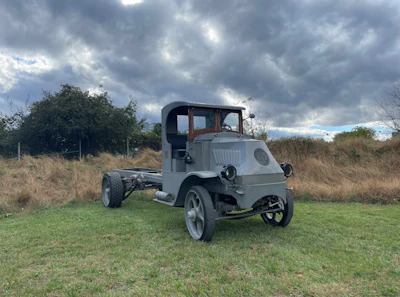
The Mack brothers started building their iconic trucks in 1900. One of its early models that ran bus routes in Manhattan, logged over a million miles, says Andrea Brown, director of product management for Mack Trucks Propulsion and VGNA regulatory.
The company's bulldog, one of the most famous symbols of the trucking industry, came from the Mack AC, called the Bulldog Mack during World War I for it's snubbed nose. Its inline four-cylinder gas engine developed 74 horsepower and leant its reputation to the term "built like a Mack truck" to describe anything sturdy.
Mack designed its engines in-house from the 1950s onwards, including the Maxidyne, which combined high torque rise with a broader power band than competing engines. It reduced shifting and improved productivity, Brown says.
Starting with the company's next engine, the E7, Mack started including electronic enhancements to develop more power in its diesel engines. These included variable injection timing and a vehicle management and control (VMAC) system to manage engines and other truck systems. These advances equipped Mack for increasingly robust emissions regulations and engine models up to the present.
"The history of Mack engines mirrors the history of American industrial progress," Brown says, and that includes advances in renewable diesel. She says Mack's latest engines aren't impacted at all by using renewable R100 diesel.
"I think that it's definitely promising, and as we find more ways to incorporate diesel from renewable sources, it's definitely promising," she says.