











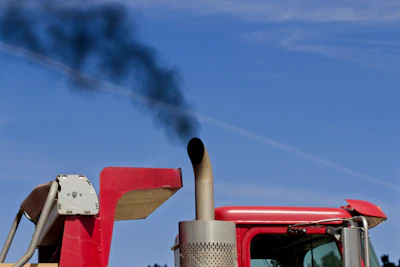
The Engine Technology Forum (ETF) hosted a webinar on Monday, Making Diesel Clean: What You Need to Know About SCR and DEF. During the webinar, experts discussed the role of selective catalytic reduction (SCR) and diesel exhaust fluid (DEF), especially in. light of recent EPA guidance.
"SCR and DEF have been central to more than a decade of clean air progress in the United States," says Allen Schaeffer, ETF's executive director. "Recent EPA guidance is focused on improving real-world operability and reliability — not on rolling back emissions standards. Our goal with this webinar was to provide policymakers with a clear , fact-based understanding of how these systems work and why they matter."
[RELATED: EPA tosses out foundation of GHG emission regs]
SCR adoption came from EPA rules requiring a more than 95% reduction in NOx and particulate matter from diesel engines. These rules took effect in 2010 for on-highway vehicles in 2010 and 2014 for off-highway vehicles.
Dr. Louise Arnold, director of government affairs, Americas, at Johnson Matthey, says SCR allows manufacturers to overcome the traditional tradeoff between efficiency and emissions.
"Diesel engines are inherently efficient, but the conditions that improve efficiency also generate more NOx," Arnold says. "SCR makes it possible to optimize engines for fuel efficiency and performance, while managing NOx downstream in the exhaust. That flexibility is why SCR has become the globally favored solution for heavy duty, off road and stationary engines."
[RELATED: DEF solves emissions problems but needs its own maintenance]
Experts also talked about misconceptions about DEF availability and quality. Alan Smith, senior director of focus industries at Brenntag North America, highlighted the scale and resilience of the DEF market.
"DEF infrastructure was built to meet regulatory requirements but it has matured into a highly reliable, nationwide supply system," Smith says. "Today, DEF is widely available through retail outlets, bulk delivery and on-site fueling for fleets and equipment operations, with strong industry quality controls at every level."

North American DEF consumption is projected to hit 1.46 billion gallons this year, supported by thousands of retail locations and more than a thousand distributors. Quality incidents are rare, experts say, reflecting industry-wide stewardship and testing practices.
In August 2025 and March 2026, the EPA issued guidance on SCR and DEF compliance strategies, providing manufacturers with additional time and mileage before engine derates occur, a reduced severity of final derates, and flexibility to rely on NOx sensors rather than DEF quality sensors where appropriate.
ETF presenters stressed the guidance doesn't eliminate DEF, weaken emissions standards, permit tampering or the disabling of emissions controls.
"Emissions standards remain fully in place, including more stringent NOx requirements coming for future model years," Schaeffer says. "EPA's guidance gives manufacturers flexibility in how compliance is achieved while preserving the environmental and public health benefits of SCR."