










Here's what you need to know
- The Supreme Court ruled Friday presidents cannot use a 1977 emergency powers act to levy tariffs.
- The case now goes back down to lower courts to sort out any possible refunds or rebates.
- The news comes the same day as new data show the U.S. economy missed growth expectations. In reaction to the decision, Trump at first announced a new, 10% tariff on top of other, previously announced levies. Then, on Saturday, he announced it would be a 15% tariff instead.
Editor's note: This story was updated Saturday afternoon with news of Trump's new, 15% tariff.
President Donald J. Trump wrote on Truth Social on Saturday that he would move a new, global tariff to 15% instead of 10% as stated in the executive order signed Friday evening.
The post indicated Trump was still angry with justices over the decision.
"Based on a thorough, detailed, and complete review of the ridiculous, poorly written, and extraordinarily anti-American decision on Tariffs issued yesterday, after MANY months of contemplation, by the United States Supreme Court, please let this statement serve to represent that I, as President of the United States of America, will be, effective immediately, raising the 10% Worldwide Tariff on Countries, many of which have been “ripping” the U.S. off for decades, without retribution (until I came along!), to the fully allowed, and legally tested, 15% level," he writes on Truth Social. "During the next short number of months, the Trump Administration will determine and issue the new and legally permissible Tariffs, which will continue our extraordinarily successful process of Making America Great Again — GREATER THAN EVER BEFORE!!!"
There were no details on when Trump would officially sign orders raising Friday's tariff to 15%. Friday's order was issued under Section 122 of the Trade Act of 1974. The tariffs struck down by the court were issued under the 1977 International Emergency Economic Powers Act.
The original story follows below. It was updated at 2:24 p.m. Eastern on Friday, after President Donald J. Trump held a news conference on the Supreme Court ruling.
The Supreme Court on Friday ruled in a 6-3 decision that President Donald J. Trump exceeded his authority when imposing tariffs using the 1977 International Emergency Economic Powers Act.
Reacting to the decision, Trump announced a new, 10% tariff on top of all other tariffs.
In Learning Resources Inc., et al vs. Trump, the court held that act does not authorize the president to impose tariffs. Chief Justice John Roberts delivered the court's opinion. In it, he emphasized just how important the power of taxation is.

"The power to tax was, Alexander Hamilton explained, 'the most important of the authorities proposed to be conferred upon the Union,'" Roberts wrote. "It is both a 'power to destroy' ... and a power 'necessary to the existence and prosperity of a nation' — 'the one great power upon which the whole national fabric is based.'"
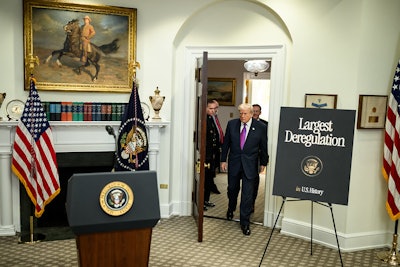
In a news conference later Friday, Trump railed against the decision, calling the decision deeply disappointing and saying he was ashamed of certain members of the court. He also alleged the court was under the influence of foreign actors.
"They're against anything that makes America strong, healthy and great again," he says, adding later on that "you'll find out" when members of the media asked him about evidence of foreign influence on the justices.
The background
Just after taking office last year, Trump enacted a sweeping round of tariffs he says address the influx of illegal drugs and immigration from Canada, Mexico and China.
"Previous Administrations failed to fully leverage America's economic position as a tool to secure our borders against illegal migration and combat the scourge of fentanyl, preferring to let problems fester," the White House wrote. "Tariffs are a powerful, proven source of leverage for protecting the national interest."
At that time, Trump's tariffs were 25% on Canada and Mexico and a 10% additional tariff on imports from China. Energy resources had a lower, 10% tariff.
The president also declared that trade deficits were a national emergency and invoked his authority under IEEPA to respond to those. He imposed at least 10% tariffs on each nation the U.S. had a deficit with. Since initially issuing each set of tariffs, the administration has adjusted them in various ways.
Who sued and why?
Learning Resources is an Illinois educational toy company. It and affiliate hand2mind Inc. produce toys focused on STEM learning, social emotional learning, reading and more. Rick Woldenberg is CEO of both family owned companies.
Most of the companies' toys were produced overseas and the Trump tariffs were "asphyxiating," Woldenberg told Education Week. "It was not survivable."
Woldenberg's companies filed suit in the United States District Court for the District of Columbia, and that court denied the government's motion to move the case to the United States Court of International Trade (CIT). It then concluded IEEPA did not grant the president power to impose tariffs.
Meanwhile, VOS Selections, a family owned New York company that imports artisan wines and spirits, sued in the CIT, alleging the same. The CIT granted a summary judgment for the plaintiffs, saying Trump did not have the authority to issue tariffs. Both cases then moved to the Supreme Court.
The court heard arguments Nov. 5.
The ruling
Justices didn't buy the government's application of IEEPA, submitting a 6-3 decision. Chief Justice John Roberts provided the majority opinion; dissenting judges were Clarence Thomas, Samuel Alito and Brett Kavanaugh.
The law was enacted in 1977 and allows the president, when there is an emergency, the power to regulate a variety of economic transactions. Since its enactment, IEEPA has been used 77 times. Some recent instances of use include by President Barack Obama against cybercriminals in 2015 and by President George W. Bush to freeze terrorist assets after Sept. 11, 2001.
[RELATED: Free trade is dead: How Trump's tariff tactics are rewriting Federal budgeting and governance]
"The Government reads IEEPA to give the President power to unilaterally impose unbounded tariffs," it wrote, adding no president ever has used IEEPA to enact tariffs. "On this reading moreover, the President is unconstrained by the significant procedural limitations in other tariff statutes and free to issue a dizzying array of modifications at will. All it takes to unlock that extraordinary power is a Presidential declaration of emergency, which the Government asserts is unreviewable. And the only way of restraining that exercise of power is a veto-proof majority in Congress."
Allowing Trump to declare IEEPA tariffs at will is a new and sweeping power, the court says, and one that is unconstitutional.
"The President asserts the extraordinary power to unilaterally impose tariffs of unlimited amount, duration and scope," the court says. "In light of the breadth, history and constitutional context of that asserted authority, he must identify clear congressional authorization to exercise it. ... The Government points to no statute in which Congress used the word 'regulate' to authorize taxation. And until now no President has read IEEPA to confer such power."
MEMA, The Vehicle Suppliers Association, welcomed the decision.
"Suppliers operate within a deeply integrated North American supply chain, and policy changes of this scale have broad and complex implications for production, investment and competitiveness," the organization says in a statement. "Vehicle suppliers are a foundational part of the U.S. mobility sector, supporting domestic manufacturing, innovation and jobs in communities nationwide. As the details and provisions of the Court's decision are implemented, it will be important to provide clarity and predictability for manufacturers of all sizes."
So, what does this mean?
Tariffs have been collected since the announcements with varying claims as to how much money the federal government has taken in.
U.S. Customers and Border Protection says it has taken in $200 billion in tariffs after Trump's executive orders, including the IEEPA tariffs but also levies introduced under reciprocal tariffs and Section 232 tariffs, which are different and remain in place even after this ruling. Those tariffs are enacted under the Trade Expansion Act of 1962 and allow for taxes if the Commerce secretary determines specific goods, such as steel or aluminum, threaten to impair national security.
The Cato Institute says, specifically, the federal government collected $129 billion in fentanyl tariffs and IEEPA tariffs as of Dec. 10. The Tax Foundation estimates IEEPA tariffs increased taxes on American households by about $1,000 in 2025.
Several groups, including the National Retail Federation, are pushing for rebates or refunds of collected tariffs to businesses and families.
"We paid the tariffs. We deserve our money back," says one letter from a small business organization, We Pay the Tariffs. "American small businesses — not foreign governments — paid billions of dollars in IEEPA tariffs. We have dipped into personal savings, taken out high-interest loans, laid off employees, and cut wages to cover costs there were never lawfully imposed."
MEMA says it looks forward to continued engagement with the proper authorities and will continue "advocating for supplier priorities to ensure fairness, clarity and timely relief."
Whether or not refunds are issued depends on lower courts' rulings and U.S. Customs. In January, Trump said refunds would be "a complete mess" and that it may not even be possible to pay. That same month, Treasury Secretary Scott Bessent told Reuters the department had plenty of cash on hand to pay the refunds, but that it would be a "corporate boondoggle."
In his Friday news conference, Trump said the ruling confirms tariffs as a viable way forward, as well as any other trade measures he may wish to impose.
"The court has given me the unquestioned right to ban all sorts of things from coming into our country," he says. "A much more powerful right than we thought we had. ... The ability to block, embargo, restrict, license or impose any other condition on a foreign country's ability to conduct trade under IEEPA has been fully confirmed by this decision."
Trump also said his administration would be enacting new Section 301 trade investigations in an effort to level even more tariffs.
"We'll be able to take in more money and there will no longer be doubt," he says.
He did not comment on whether or not the government would refund IEEPA tariffs already collected, pointing to the ruling's silence on the issue.
"I guess is has to get litigated for the next two years," he says. "We'll end up being in court for the next five years."
On the same day the court issued its ruling, the federal government released disappointing fourth-quarter GDP numbers. Data show the economy grew at just 1.4% over the final three months of the year, whiffing on the Dow Jones estimate of 2.5%.