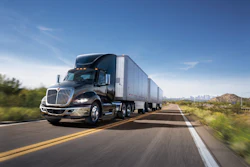












Navistar victorious in breach of contract and fraud lawsuit.
- Verdict: Michigan jury found Navistar not liable for $16.5 million in damages claimed by GLS LeasCo and Central Transport over delayed truck deliveries.
- Core dispute: Plaintiffs alleged Navistar promised to deliver 1,100 new tractors by end of May 2022 but only delivered 18 by that deadline, causing them to miss a strong used truck market and lose $15.7 million in resale value as well as incur extra maintenance costs.
- Key evidence: Jury agreed Navistar clearly communicated production delays due to component shortages and rejected plaintiff's damage model that assumed selling 480 trucks in a single month.
A Michigan jury has rejected a $16.5 million breach of contract and fraud suit against Navistar. The 10-person panel found Navistar was not liable late Monday evening.
GLS LeasCo and Warren, Mich.-based trucking fleet Central Transport (CCJ Top 250, No. 23) filed the suit in 2023 alleging Navistar had failed in 2022 to deliver new trucks as promised in a previous agreement, and that the failure cost the companies money in maintenance of older trucks as well as lost money in selling the used models. Navistar said it never promised the trucks by the deadline GLS and Central allege and there was no breach of contract or fraud.
Jurors found GLS and the other plaintiffs did not prove the allegations against Navistar and was not owed any damages.
GLS awards a contract for new Navistar trucks
GLS purchased and placed in service 630 International tractors in 2018. It entered into an optional trade-in agreement in which Navistar — now International Trucks LLC — granted the company the right to trade in the model year (MY) 2018 trucks for a specified residual value. In 2021, GLS, Summit Truck Group and Navistar reached an agreement for GLS to purchase more trucks, this time 1,305 new tractors — 1,100 MY 2023 trucks and 205 MY 2024 trucks — for $113,843 per truck.
At the time, Navistar recognized the trade-in agreement for 1,046 used trucks, including the MY 2018 models. It agreed to deliver the new 2023 trucks from February-December 2022 and the MY 2024 trucks from January-February 2023. However, before the trucks were delivered, Summit Truck Group was sold to Rush Enterprises and the two sides entered into negotiations for a new agreement, this time excluding Summit, but with the 2021 agreement still in effect.
Those negotiations resulted in a new, April 2022 letter agreement in which Navistar promised 1,100 MY 2023 trucks ranging from $116,317 each for day cabs to $137,754 each for sleepers. The day cabs would come prewired for Bendix Fusion as supply chain restrictions were crimping Navistar’s production of the models, opening up production slots for customers willing to accept prewired trucks without the system. The letter agreement said, at the time, Navistar had production slots available to produce the trucks from January-May 2022.

The 2022 letter also included a no-trade agreement that included a $6.2 million credit to Central, the GLS-affiliated transportation company that was running the MY 2018 trucks and that would use the new trucks. The credit, the letter said, covered assistance for the disposal of the trucks, rental invoices associated with delayed and future production, rental invoices associated with downtime associated with the older models, and communication devices. The companies would then sell the 941 used trucks as they saw fit. GLS is also affiliated with Universal, another transportation company that comes up in the suit.
“During the negotiation of the letter agreement and at the time the parties entered into the letter agreement, it was widely known in the trucking industry, and was specifically known to Navistar and GLS, that the market for used trucks was historically strong,” GLS’s complaint said. GLS alleges Navistar proposed earlier delivery dates for prewired trucks without Bendix Fusion to enable it to take advantage of the booming used truck market. In exchange, GLS would waive its trade-in option for the MY 2018 trucks.
“The earlier production schedule for the new tractors was a critical part of the consideration Navistar offered to GLS,” the complaint said. “GLS would never have waived its trade-in rights, including with respect to the MY 2018 tractors, in the absence of Navistar’s agreement to the earlier production schedule, which both parties understood would allow to sell the MY 2018 tractors in the historically strong re-sale market.”
GLS alleged Navistar knew it couldn’t produce the 1,100 trucks in time for it to take the 2018 units out of service and sell them in the historically strong market.
“It was entirely foreseeable to Navistar, and Navistar knew at the time the parties entered into the letter agreement, that its failure to meet the production schedule would impair GLS’s ability to take advantage of the historically strong market conditions for used tractors and could result in consequential damages in the form of resales at lower prices than would have been available if the promised production schedule was honored and fulfilled,” the complaint continued.
GLS said Navistar promised to produce the tractors by the end of May 2022, but by that time, had only delivered 18 new tractors. Deliveries stretched from June 2022 to September 2023, GLS says, costing it the opportunity to sell the used tractors at a higher price.
“During the months following the time period in which Navistar was contractually obligated … to have completed its deliveries, the price for MY 2018 tractors dropped by over 75%, causing GLS to suffer substantial damages in the form of lost sales revenue,” the complaint said. The company said GLS lost revenue and profits and racked up costs related to fuel, downtime, higher maintenance costs and driver recruitment costs related to running the older trucks.
[RELATED: J.D. Power reports used market dynamics shifting; prices fell in May 2022]
In later filings, GLS and Central would say Navistar viewed them as an undesirable customer due to the lower profit margins the companies say it achieved with them and, because of that, Navistar “picked winners and losers” when it came to build slots. Because Navistar viewed the plaintiffs as a “loser,” they allege, the company made false statements to induce the plaintiffs to enter the second, 2022 agreement that the plaintiffs say was more favorable to Navistar than the 2021 agreement and the trade in provision.
Among those false statements, the plaintiffs said, were allegations delays with Bendix Fusion’s collision mitigation system were reducing available build slots and if the plaintiffs waived their trade-in rights, they could take earlier production slots for trucks prewired for collision mitigation but without the components.
“Navistar, in fact, had no intention of providing trucks to plaintiffs on this accelerated timetable,” GLS and Central argued. “Instead, it relied on its knowledge that plaintiffs had a significant need for new trucks — trucks that Navistar had already promised and then threatened to renege on providing — and the false promise of accelerated production to induce plaintiffs into waiving contractual rights that Navistar felt were unfavorable.”
Navistar’s defense
For its part, Navistar denied it offered any consideration to GLS related to the used truck market. It also acknowledged supply chain difficulties related to Bendix Fusion installation but denies it agreed to a production schedule in the letter or that it was responsible for any lost revenue or profit, or that it sent production spots to more profitable customers or exerted pressure on GLS and Central to waive trade-in rights.
As far as truck deliveries, Navistar said it built more than 18 trucks by the end of May 2022. It says it produced 267 tractors by the end of that month for both Central and Universal. In other court filings, Navistar categorically denied the 2022 agreement had any promised delivery date at all. Instead, the company said there’s a difference between production of a truck and delivery of that same truck, saying the later can lag as much as four weeks behind the former.
“The 2022 letter agreement did not promise that Navistar would deliver all trucks by the end of June 2022 — its terms establish only production slots and build months, and plaintiffs’ own witnesses confirmed that production is different from delivery,” Navistar argued in court filings. It also argued it informed GLS that production would extend into June and July, pushing deliveries back into July and August.
The no-trade agreement in the April letter also released Navistar and waived damages into relation to the older trucks. GLS’ expert testimony also rendered a faulty estimate of any potential damages, Navistar claimed, because it relies on selling hundreds of used trucks in a single month at a high price.
Chris Kahaian, GLS’ expert, built a model estimating $15,775,097 in damages, the bulk of which stem from lost resale value and a slim portion, just over $1 million, are attributed to repairs and maintenance costs. The model, Navistar argued, assumes 480 trucks would be sold in June 2022, the same month GLS says it would take delivery of the new trucks, at a price of $63,000 per truck. However, Navistar said that despite having received 278 new trucks by August 2022, GLS had sold only 41 used trucks.
“If plaintiffs themselves could not sell even 41 trucks in three months when they actually had new MY 2023 trucks in hand, no reasonable jury could credit an assumption that they would have sold all 480 in a single month,” Navistar argued. “Tony Stinsa, Navistar’s head of used truck operations, confirmed that selling 480 day cabs in a single month would present ‘extreme difficulty’ and that even with Navistar’s extensive wholesale network, it would ‘probably take us maybe six months to sell a package of that size.’”
Navistar went on to argue that specific characteristics of the trucks — proprietary yellow paint, heavier steel wheels, smaller engines and manual transmissions — lowered the value of the truck. Kahaian, it stated, did not account for those deductions in his math, nor did he consider discounts wholesalers would demand for accepting a lot of trucks.
“A market-price model that assumes frictionless sales of hundreds of actively deployed fleet trucks is divorced from the commercial realities the trial evidence established,” Navistar said.
Deliberations and verdict
The Michigan jury agreed wholly with Navistar, finding GLS and Central failed to prove Navistar had to deliver the 2023 trucks by June 30, 2022, and that Navistar clearly told GLS and Central its production was hampered by a shortage of Bendix Fusion collision mitigation components. The plaintiffs failed to prove the restricted production wasn’t true, however, the jury said.
The plaintiffs have not said whether or not they plan to appeal.