












Class 8 truck orders exploded in December, a sudden and much needed uptick for the dealer sector after months of below average results.
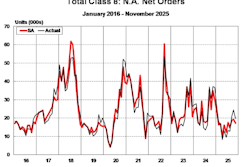
FTR reported Monday preliminary orders of 42,200 units, up 108% from November and 21% year over year. The estimate is the highest single month since October 2022 and well above the 10-year December average of 29,351 units. ACT Research reported 42,700 units, up 16% from 2024.
“After spending most of 2025 in the doldrums, amid stagnant freight rates and beset by policy and regulatory uncertainty, new vehicle demand jolted awake in December,” says Carter Vieth, research analyst at ACT Research. “A firmer economic foundation, increasingly aged fleets and the certainty of higher costs and new technologies in 2027 were the impetus, in our opinion, for the sudden change of heart. As trucking fundamentals remain thin, if improving, we view December’s Class 8 result as overstating the improvement.”
[RELATED: Dealers eye 2026 recovery but remain honest about market limitations]
Within the numbers, FTR reported both the on-highway and vocational markets saw similar percentage gains relative to the prior month, with on-highway made up the bulk of the year-over-year increase in orders. The company states a key driver of the strong December order performance was improved policy visibility on both tariffs and emissions regulations following clarifications in October and November.
The Section 232 tariffs on Class 3-8 trucks implemented on Nov. 1, 2025, turned out to be less onerous than many had feared, and regulatory uncertainty has eased. The Environmental Protection Agency (EPA) is expected to propose revisions to the 2027 NOx rule in March or April that would retain the 2027 implementation date and the 0.035 g/hp-hr standard while eliminating the costly extended warranty requirements and modifying other compliance provisions. Word of EPA’s plan did not circulate until about 10 days before Thanksgiving, which probably is a factor in why the order surge occurred during December and not November.
“Despite greater policy clarity, freight demand remains soft, fleet profitability is constrained, and capital spending discipline persists amid rising costs,” says Dan Moyer, FTR senior analyst, commercial vehicles. “As a result, December’s order strength likely reflects the release of deferred orders along with the early stages of a modest EPA 2027 NOx pre-buy rather than a broader demand inflection. A more durable recovery in equipment demand will require a sustained improvement in underlying economic and freight market conditions.”
[RELATED: How Rush remains engaged with truck buyers despite flagging market]
FTR adds despite the strong performance in December, cumulative 2026-season net orders from September through December were down 22% year over year, reflecting broad market headwinds. Class 8 orders have totaled 22,178 units for the past 12 months, the company says.