











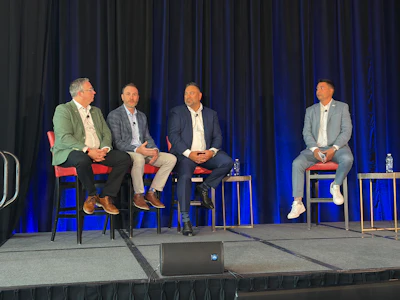
Is consolidation taking the independence out of the independent aftermarket? That was just one of several hot buttons pushed during Hier et Demain, a leadership panel discussion Friday during the Commercial Vehicle Solutions Network (CVSN) Executive Summit in Montreal.
Featuring Steve Bashir, president, Heavy Duty at Dayton Parts; Kurt Gustafson, senior director of operations and Cox/Northeast Great Dane; and Marc-Philippe Beaudoin, vice president, product management, Heavy Duty at UAP; and moderated by Bruno Gattamorta, CCO at Cojali USA, Friday’s discussion ping ponged across many of the aftermarket’s biggest challenges and obstacles, from consolidation and brand loyalty to product identification, AI implementation, online sales competition, workforce development and more.
On the aforementioned M&A question, the panel was unanimous that one distributor or vendor buying another doesn’t intrinsically reduce the freedom of the distribution channel. The strength of the aftermarket has always been options, both in brands and points of sale. Consolidation can temporarily reduce those options but the industry also is growing, with new parts vendors and digital or physical storefronts opening all the time. And the panelists believe the latter is occurring faster than the former.
Brand influence waning
It’s branding where the panelists believe industry’s biggest transformation is occurring.
A decade ago, Beaudoin said vendors could still thrive in the aftermarket on brand name alone. No longer. He said today’s customers are much less concerned by the name on the box than they are by its availability or cost. UAP still carries and supports many premium brands, but Beaudoin believes the company’s success in the marketplace is driven far more by its fulfillment capabilities and ability to solve customer challenges promptly.
[RELATED: Cummins executive confirms plans to offset EPA penalties with pricing]
And Bashir believes understanding the latter is essential for any brand that wants to remain on top. He said today’s brands don’t just need to deliver a quality product, they need to deliver on promises. To solve problems happening in the market every day in ways that resonate with customer.

“When you can no longer do those basics, then brand quality begins to erode and it can be hard to come back to that,” Bashir said.
Finding the right part
On the other topics of the day, the panelists were again in agreement on the essentiality of parts identification to the future of the channel, with Bashir stating product data collection should begin the instant a product goes into development, not once it is ready to be sold. As the panel’s lone service provider representative, Gustafson stressed the easier a part is to identify, the more likely it becomes a favorite of technicians.
On AI and the digitization of the aftermarket, the panelists all noted their businesses are investing in AI solutions to strengthen their operations and anticipate investing more into those resources in the future. The panelists acknowledged AI could create efficiencies that reduce headcount in some areas but don’t see the technology ultimately as a workforce reduction tool. If anything, they’re hopeful it will tilt the other way — streamlining some functions so employees can be reallocated to more pressing areas like customer service.
“Any time you’re touching a customer, that’s too important to be automated,” Bashir said.
Workforce development still a priority
And the three panelists all want to add workers, and believe finding and training the best talent possible remains the most influential driver of business success. Which is why workforce development is so important. Beaudoin said this is one area where consolidation and scale are particularly useful; as businesses grow, investments must be made into workforce structures to sustain success.
Gustafson agreed. And again noted as a service provider, one of the biggest challenges his company faces is recruiting talented technicians who exit the business prematurely because they erroneously believe there is no career path available to them. There are more jobs in the service sector than technician or manager, he said. The aftermarket must make that clear, and show young associates the veteran technicians they see in their shop are not their destiny.
He calls those senior techs Mike, and said young people “respect the hell out of Mike, but they don’t want to be Mike.”
 Laura Huang speaks during the CVSN Summit Friday in Montreal.
Keynote speaker shows how intuition can be quantified into business success
Friday’s events also featured a keynote presentation on building a lasting legacy from author Laura Huang. An established university professor and researcher, Huang says her work has focused on studying success and trying to understand things we often believe are unquantifiable, such as gut feel, intuition and more.
Huang admits quantifying success is challenging. There’s no simple formula that determines exactly how gut feel works. But over time, Huang says she’s discovered variables that drive success, or failure.
On the latter, she says far too often in business, people become constrained by their own pre-conceived notions. They look at what they have available and try to ideate from there. But that’s limiting. Huang says her research indicates successful leaders look beyond what they have and find new, wholly original opportunities.
[RELATED: Registration open for HDAW 2027]
Her research also shows that there are times where gut feel and intuition are more valuable than other times. She says with simple problems and complicated problems, relying on a gut feeling can often by detrimental. She says simple problems usually have a right and wrong answer so the best path forward is evaluating the problem and collecting data to find the correct answer. Huang believes complicated problems are trickier, but are often ultimately just a series of simple problems stacked together. Taking time to evaluate the entirety of the problem will often enable similar success.
But with the truly complex and chaotic problems, Huang says intuition is a resource because the all the data required to solve them is likely unavailable. And her data shows when a decision maker is unable to acquire all the resources necessary to recognize a solution, relying on experience and career knowledge is useful.
“We should always rely on our experience because we will never have all the information we need,” she says.