











Tariff-related price inflation drove most independent aftermarket growth across the United States and Canada in 2025 but is anticipated to be less of a factor in 2026, MacKay & Company reported Monday at Heavy Duty Aftermarket Dialogue in Grapevine, Texas, presented by MacKay & Company and MEMA.
Dave Kalvelage, MacKay & Company’s client consultant and senior market analyst, says the U.S. aftermarket for Classes 6-8 trucks, trailers and container chassis outpaced industry projections to grow by 5.0% last year. In Canada the market was up 3.9%. Normally, Kalvelage says that level of growth would be met with rejoicing, especially in a year where freight remained depressed, but last year was not a conventional year.
Trade and tariff activity from Washington created economic volatility almost immediately after MacKay & Company released its forecast at last year’s HDAD, and the uncertainty continued throughout the year.
[RELATED: Agility in a complex market key to success in 2026, DTNA aftermarket exec says]
As distributors shared with MEMA in advance of Monday’s event, last year was a tough one to manage. Business didn’t turn around like anticipated. Customer profitability remained low and limited sales opportunities. Kalvelage says price accounted for 4.0% of last year’s 5.0% growth, outpacing the 2.5% price increase MacKay had predicted and inflating the market’s overall expansion.
And turning things around in 2026 is going to require some outside help.
MacKay & Company Economist Bob Dieli hit leadoff ahead of Kalvelage’s aftermarket presentation Monday and covered the general U.S. and trucking economies. Dieli said the recessionary indicators that existed in the economy last January are still there.
The economy is still in the boom phase of the business cycle (for the third year in a row).
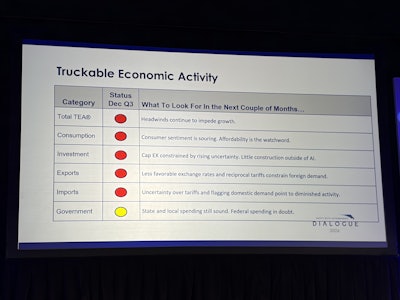
Additionally, Dieli’s Truckable Economic Activity (TEA) metric is neutral or negative in all categories (see above image), and despite some trade stability in recent months, the USMCA review by all parties and U.S. Supreme Court ruling on the validity of President Donald J. Trump’s IEEPA tariffs must be conducted by June. Coupled with the impending ouster of Federal Reserve Chairman Jerome Powell and choosing of his successor, Dieli says there’s a lot that could happen in the next six months that could drive major economic changes.

Does that make a recession inevitable?
Well, no. Dieli jokes “the strong answer is maybe,” but it does demonstrate how precarious the economy is in its current state. He adds, “What we want is for things to remain the same but get better,” but turning that hope into a reality is beyond the industry’s control.
 Bob Dieli, economist at MacKay & Company, shows a chart displaying the Fed Funds Rate under each recent chair during HDAD. Dieli astutely notes the rate "does not change direction when it changes color," meaning a new Fed chair does not ensure a policy shift.
Fortunately, Kalvelage says indicators within the trucking sector are better.
MacKay & Company research indicates capacity equilibrium is near and forecasts truck and trailer utilization to rise in 2026, along with new equipment demand. Kalvelage also says fleets, dealers and distributors alike hunger for price stabilization, while Dieli says trade clarity could boost imports, inventory levels and manufacturing investment.
[RELATED: Suppliers focused on efficiency, data distribution and production capacity for 2026]
Overall, Kalvelage says MacKay & Company is predicting 3.9% growth for the U.S. aftermarket in 2026, with Canada slightly lower at 3.5%. He adds the company has 2.5% price increases for both nations. Looking out further, Kalvelage says MacKay & Company has a 3.5% compound annual growth rate (CAGR) the U.S. market until 2030, growing the sector from $54.4 billion in 2025 to $64.5 billion in 2030. In Canada the CAGR is 2.8%, growing the market from $7 billion to $7.8 billion.
Without a larger economic boom to point to, Kalvelage says the forecasts are “primarily driven by growth in the population of operating vehicles.”
 MacKay & Company's Classes 6-8, trailer and container chassis aftermarket forecasts from 2025 and 2026.