











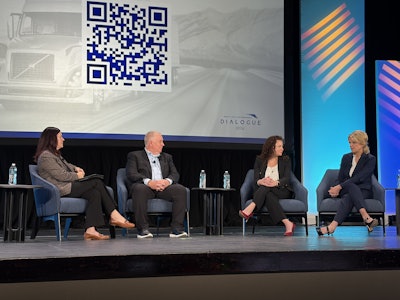
Turning technology into efficiency and creating resources for fleets and distributor partners are top priorities for aftermarket suppliers in the year ahead, shared a supplier panel during Heavy Duty Aftermarket Dialogue, presented by MEMA and MacKay & Company, Monday in Grapevine, Texas.
Moderated by MEMA Aftermarket Suppliers President Emily Poladian, Monday’s panel covered a wide range of topics, including market status and 2026 predictions, OE vs. aftermarket production, AI implementation, fleet outreach, distributor and service provider training and more.
Panelists Tim Bauer of Eaton, Nicole Oreskovic of Bendix CVS, and Paige Petroni at Fontaine Fifth Wheel were in agreement on nearly all topics during the conversation, stating for that their operations, 2026 must be a year of improvement in all areas. In many ways, the aftermarket has survived the freight recession better than any other trucking segment, but the panelists said just because their operations and their distributors are doing okay, that doesn’t mean their operations are flawless.
[RELATED: Planning positions suppliers for growth when recovery starts]
The panelists said there are a lot of ways their operations and aftermarket suppliers market wide can get better. And they have to. The customer base demands it.
Oreskovic says Bendix is “focusing to make sure independent aftermarket has the tools” necessary to meet any customer demand, whether that’s at the counter, in the field or online.
Oreskovic said one of the hardest parts for Bendix in today’s aftermarket is simply data dissemination. She said Bendix’s aftermarket business doesn’t just sell parts for equipment immediately coming out of warranty, it also must have parts for trucks that hit the aftermarket five or 10 years ago and be considering aftermarket demand for components going into OE production today. That product breadth requires an unbelievable amount of data for distributors and customers alike to access and use to ensure the right parts are installed at the right time. Oreskovic said Bendix is trying to use lots of technology, including AI, to make that data available. Catalogs won’t cut it anymore, she said.

“We have to use advanced technology as a supplier to make that information available,” she said. “We have to listen to our customers and provide what they need from us and not what we want to deliver to them.”
Bauer agreed. He said Eaton is working to implement solutions to improve communication through distributors and direct to fleets to ensure they have the materials necessary to get trucks back on the road, because “if their wheels aren’t moving they aren’t making money.”
He also noted that the better Eaton and other aftermarket suppliers can communicate product information digitally into the field, the better they can maximize their “boots on the ground” efforts to focus on areas where additional support is required.
And Petroni said that’s a good point. Fontaine and other suppliers aren’t leveraging AI and digital tools to streamline customer interactions in place of personal relationships, but to enhance them. She said Fontaine hasn’t lost a single employee due to added technology — the tech is allowing her workforce to do more, to connect with distributors and customers better than they ever have.
“There’s a really good, sweet spot where we can be tech savvy but still keep that level of interaction,” she said.
But Monday’s panelists also were in agreeance that bolstering communication alone won’t ensure success in the next market upturn. Vendors also must have product available to meet any customer’s needs, and have a resilient supply chain that can deliver on promises.
Bauer said fleets today are cannibalizing trucks, and historically when that’s happening the truckload cycle is typically close to the bottom. Which means Eaton and other vendors should be preparing today for a market uptick tomorrow.
Oreskovic said Bendix feels the same. She noted it’s hard to prepare “when you don’t know the degree” at which the market will turn around, but said Bendix has to plan to outpace the uptick so it can supply its entire customer base.
“Aftermarket supply is as important as the OE supply. We have to do both,” she said.
Petroni also noted suppliers can’t fall into complacency after weaker recent years. She said she’s challenging Fontaine’s team to be in a growth mindset entering 2026 even though the market hasn’t yet increased.
“Things happen so quickly even though in the moment it feels like its dragging along,” she said. “We are positioning ourselves to be ready for when that happens.”
 MEMA Aftermarket Suppliers Senior Director and Commercial Vehicle Lead Shannon O'Brien revealed insights from her 'Talk From the Top' aftermarket executive survey during Heavy Duty Aftermarket Dialogue Monday in Grapevine, Texas.
‘Talk From the Top’ reveals distributor feelings on market, vendor needs
Similarly, aftermarket distribution executives believe the third time will be the charm for an industry turnaround in the second half of the year, Shannon O’Brien, senior director and commercial vehicle lead at MEMA Aftermarket Suppliers, also shared from her most recent ‘Talk From the Top’ industry survey during Dialogue on Monday.
O’Brien’s Talk from the Top program was launched in 2024 as a way for MEMA members gain vital, first-hand assessments of the aftermarket from their distributor partners. During Monday’s presentation, O’Brien shared distributors enter 2026 with guarded optimism. Many admitted 2025 was a struggle — more challenging than they had anticipated last January due to trade and tariff-related volatility and the extended freight recession — but also noted the final months of the year saw some normalization. In some cases business even stabilized or improved.
[RELATED: Agility in a complex market key to success in 2026, DTNA aftermarket exec says]
As such, O’Brien said many operations used last year to improve their internal business practices and efficiencies, “getting the house in order” for the next market turnaround.
And O’Brien said most executives she spoke with are hopeful that turnaround will eventually arrive in the second half of 2026 — even if they’ve predicted that timeline before.
Looking beyond the market, O’Brien shared several other key insights for the suppliers in the audience on product reception and development, training and more.
On the former, O’Brien said her survey interviews revealed the aftermarket (and its customer base’s) acceptance of value line and private label products are at an all-time high. Fleet profitability has slipped to a level where every customer is cost-conscious, O’Brien said, and distributors are mostly responding by buying and selling product lines to support that. She said many distributors acknowledged they’d like to continue selling genuine product lines but brand doesn’t carry the same way it used to. Private label quality is improving too.
“If someone is making one almost as good for 30% less, what would you buy in your personal life?” she said, echoing a distributor responder.
As for training, expectedly, O’Brien said distributors remain hungry for knowledge, though they do have preferences for how that information is provided.
“[Distributors] want less of a commercial and more of a ‘help us do the job’ session,” she said, adding it also helps when suppliers build different training for different roles, or products, rather than one-size-fits-all courses that can take a while to complete.
She also noted training can’t be avoided. Distributors expect vendors to only continue investing in product information, online resources and other tools to make their jobs easier.