











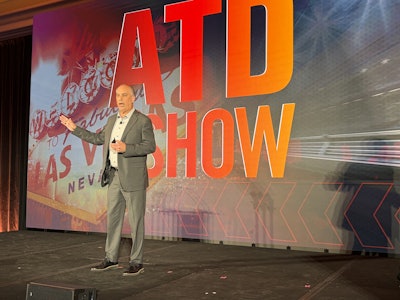
In an industry that becomes more technologically complex with each passing day, Daimler Truck North America’s (DTNA) David Carson, senior vice president of sales and marketing, still believes relationships are the secret sauce to market success.
Speaking Tuesday at the opening general session of the 2026 American Truck Dealers (ATD) Show in Las Vegas, Carson acknowledged the days of ‘dumb trucks’ are over.
He said ATD and the trucking industry have earned much needed wins on the regulatory front in the past 12 months, and while those victories might slow the adoption of some technologies, they won’t stop the proliferation of others. Today’s fleets demand intelligent, efficient and safe equipment to maximize their revenue potential and avoid crippling litigation.
“The days of fully mechanical propulsion systems are gone,” he said. “Some of you may hate that, but we can’t go back.”
[RELATED: EPA looking to permanently end diesel derates]
Which means the industry must move forward. Carson said that’s where dealers come in. As the customer-facing touch points to North America’s trucking fleet, Carson said dealers are vital to ensuring carriers continue to get the most out of their equipment.
Whether that be connected technologies, autonomous solutions, alternative propulsion options or even AI, Carson said that depends on the customer and its desires. He said what matters for dealers is ensuring no matter what technology journey a customer enters into, their dealer partner is ready, willing and able to help them make the best decisions for their business.
He said the business environment for customers is more complex than it has ever been and the pace of change is only accelerating. They shouldn’t be expected to manage it alone, Carson added, and will value partners that shrewdly support them.
“However we’ve done it up to this point, that is not the way we can do it, or will do it, in the future,” he said.
But what does that mean, exactly?
A fleet customer becoming more reliant on vehicle data and accepting of technical innovation may require fewer engine overhauls, but they will still require dealers with service bays. Carson believes where OEMs and their dealer networks can succeed is in best understanding and predicting how customers will receive and analyze data and beating them to actionable solutions that keep their equipment on the road.

He said connectivity “presents an opportunity for all of us to create revenue opportunities” and believes dealers should gravitate toward those revenue streams.
He also noted the main tenets of customer service aren’t changing, even if the products and solutions offered might be.
“How do we manage so the customer wins every time?” he said.