








Recovery is waiting in the wings, says American Trucking Associations economist Emily Clayton, but it's a supply-based recovery.
"Unfortunately, supply recoveries are ugly for everyone involved," Clayton says.
Supply recoveries occur when, specific to this industry, the number of available trucks to haul freight fall to meet the level of demand. And with little to show more demand, such as housing starts or manufacturing outputs, that means a good many trucks — and fleets — will stop rolling.
"It's going to be a rocky climb back up to normal," Clayton says.
[RELATED: Factors that could ignite Class 8 demand are finally improving]
She showed just how rocky during a Wednesday webinar from MEMA that gave an update on the economy and trucking industry. Tariffs and economic uncertainty that played havoc during 2025 will continue to affect the macroeconomic picture in 2026.
Tariffs are putting pressure on several sectors that play into the freight market, such as single family housing starts, auto sales and goods imports. The trade policies are making it difficult to stimulate the economy even with the tax cuts and Federal Reserve rate cuts. Effective tariff rates are the highest in almost 100 years, Clayton says.
"Any benefits that will come from these tariffs are well in the future," she says. "All of the costs, like the inflation, are going to hit way sooner than any benefits."
And we haven't seen the full brunt of the inflation yet, either, Clayton says. Since 2020, prices are up 27% and that's going to go up as merchants restock and get hit by tariff costs. Even though the Fed is expected to cut interest rates two more times this year, Clayton says don't expect them to help much.
Tariffs aren't just affecting consumer goods. Clayton says about half of U.S. imports are inputs to factories.
"Higher tariffs are really hard on U.S. manufacturers," Clayton says. She pointed to manufacturing employment getting hammered since the first round of tariffs were announced last year, losing more than 80,000 jobs.
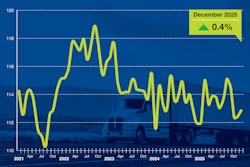
All of these factors translate into less freight to be hauled. Clayton showed the precipitous decline in freight rates, including drops in contract and spot market proxies.
"The demand is just not there," Clayton says.
Costs are, though. Clayton's presentation showed a 3.6% increase in operational costs in 2024, the latest year for which data is available. That's markedly lower than the nearly 10% seen in 2021-2022, but it's still painful. Excluding fuel expenses, Clayton says the operational cost of trucking is 26% higher than freight rates.
"There's a huge delta there that fleets just cannot afford," she says.
When they can't afford it, they go under. Clayton says there's been an 11.6% drop in the number of carriers with interstate operating authority since December 2022.
"That's a pretty big shedding and we're continuing to see carriers leave as this market is just uninhabitable for many," she says.
The market's not just shedding jobs, but also equipment, Clayton says. The biggest losses came in 2024 and 2025, with last year showing a more than 20% drop in Class 8 sales. This year, ATA expects a slight bump, but tractor sales are still forecast to be off quite a bit.
"We're not seeing a big rebound this year," Clayton says.
MEMA's Philip Atkins, director of strategic research and planning, presented results of a suppliers survey that showed companies aren't expecting a big rebound. The survey showed "quite a hangover" from a tough 2025. Companies, 78% of them, are expecting sales to be down for 2026. And, the numbers show, it's the economy.
[RELATED: The ‘wait-and-see’ year: How 2025 uncertainty will shape 2026 aftermarket strategies]
More than 60% of respondents were pessimistic about the U.S. economy and nearly 70% were pessimistic about the global economy.
"The economy ... is introducing a lot of uncertainty into the equation," Atkins says.
Sales did show some improvement toward the end of 2025, Atkins says, and attitudes also improved along with the numbers. The independent aftermarket showed the most improvement, with nearly half of respondents showing year over year gains and fewer respondents reporting declining sales in the fourth quarter.
"That's a bright spot," Atkins says.
The OE side was slower with 31% of respondents showing declines chalked up to poor market conditions. Atkins says overall, the survey shows "tempered optimism" that increased as the year went on. Atkins says the year-end boost is why sales plans are depressed while year-end outlooks were more bright.
"There was a pretty sharp change in the national sentiment," he explains.