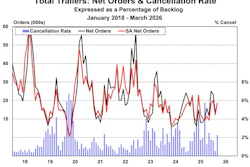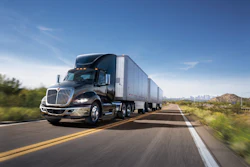













Spring's early trailer orders are going strong, ACT Research and FTR Transportation Intelligence says. ACT had preliminary net trailers up a whopping 126% year over year while FTR shows a 100% increase year over year.
They were just up 3% month over month, but ACT's Jennifer McNealy says it's still surprising for a historically tepid month.
"A sequential drop in net orders is typically expected as April traditionally marks the second consecutive month of 'weakest' months of the annual order cycle," says Jennifer McNealy, director of commercial vehicle market reserach and publications at ACT. "That said, this year's cycle seems to have been delayed a few months, as the order upticks that should have started in September or October of last year didn't actually happen until December. Regardless of the timing, the order upticks are certainly welcome."

FTR has net orders coming in 11% month over month, landing at 19,953 units. Builds were essentially flat, the company says, indicating continued production discipline among trailer manufacturers.
[RELATED: Nominate a business for the Trailblazer Award!]
"Overall, the U.S. trailer market appears to be moving from deterioration toward stabilization and modest improvement," says FTR's Dan Moyer, senior analyst for commercial vehicles. "Freight conditions are improving in pockets, but the recent rebound remains driven mainly by replacement demand and selective fleet activity rather than broad expansion. Trailers should therefore continue to lag Class 8 in the near term with improvement concentrated among stronger fleets, aged equipment replacement and dry van normalization."
[RELATED: ACT: Driver capacity and regulatory clarity prop up Class 8 orders]
As freight rates rise and carriers become more confident in the state of the market, McNealy says analysts know have a better idea of what a trailer recovery would look like.
"But it remains to be seen how the final two months of Q2 will unfold," she says. "Additionally, concern is mounting about how quickly trailer OEMs will build down the relatively still-thin backlog, particularly given concerns about the level of activity in the key freight-generating economic sectors that drive transportation demand and high petroleum prices that weigh on purchasing decisions for both consumers and fleets."

Moyer says cost and policy risks remain key overhangs and may already be shaping demand for trailers, especially a change in how the Section 232 steel and aluminum tariffs are applied as well as van trailer antidumping and countervailing duties investigation.
"April trailer demand was better than expected but a durable upcycle will likely require stronger fleet margins, higher trailer utilization, further absorption of excess capacity and clearer visibility into trade-related costs," he says.