











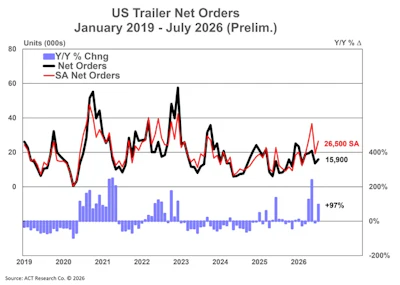
Trailer orders surprised last month, rising by 2,400 units from June to 15,900 units in July, ACT Research reported Tuesday.
That total was more than 8,000 units higher than July 2025, up 97%. ACT notes the improvement is impressive but must acknowledge the weakness of the market last year, which it calls a “very tepid environment.”
Seasonal adjustment (SA) at this point in the annual order cycle takes the month’s volume to 26,500 units. Final July trailer industry data will be available later this month, the company says.
“After one month of seasonally-expected slowing, July net orders returned to the historically-counter pattern witnessed earlier this spring,” says Jennifer McNealy, director of CV market research and publications at ACT Research. “Typically, July is the weakest net order month of the annual ordering cycle, as fleets have made their decisions for current-year needs and OEMs start to build down the backlog.”
[RELATED: Great Dane releases newest flatbed into market]
But McNealy adds this year’s cycle has been anything but ordinary.
“The order strength that should have started in September or October of last year didn’t actually begin until December,” she says. “The atypical strength in orders continues to reflect improving trucking fundamentals, buttressed by rising freight rates.”
She continues and notes regardless of the timing, the increased order activity is certainly welcome, but premature in terms of 2027 order timing and the opening by OEMs of next year’s calendars. Additionally, McNealy says caution remains a strategy for some trailer purchasers. Freight rates are rising now, but the past few years have been hard for carriers, and now the challenges of strong pent-up demand and the risks of higher maintenance costs and downtime to repair rather than purchase new equipment remain as counter-weights to their decision-making process, she says.
[RELATED: MacKay & Company projects 4.8% aftermarket growth in 2026]
“In a recent monthly survey, OEMs shared with ACT Research that the uptick in order activity seems to be a three-fold event: customers ordering ahead of tariff-related price increases, healthier long-term business conditions, and pent-up replacement demand,” McNealy says.