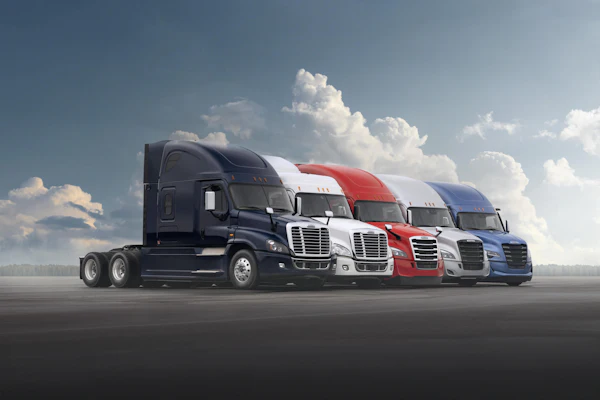













A tighter supply of quality used trucks has driven retail demand and pricing upward over the last five months, creating an “awesome” market Daimler Trucks Remarketing (DTR) President Chris Backeberg believes should last into 2027.
Backeberg admits the opening months of last year were pretty good too, but they were built on a shakier foundation. Capacity was off; freight was stagnant. The house of cards fell when tariffs were introduced and most of the rest of the year was spent in recovery.
This year feels stronger, he says. Some tariffs were scrapped. The U.S. fleet is sturdier. Freight rates and volumes are improving. Even higher diesel prices due to the conflict in Iran, thus far, are being absorbed.
“Our sales continue to be brisk,” Backeberg tells TPS. “Used trucks are at a premium.”
It’s a market Backeberg and his team are eager to attack.
As the used truck support arm of Daimler Truck North America (DTNA), Daimler Trucks Remarketing works to facilitate successful used equipment transactions between fleets and DTNA dealers.
[RELATED: Freightliner simplifies in-cab tech for 2027 Cascadia]
DTR is a critical partner for both sides, Backeberg says. For dealers, DTR is a risk management partner, capable of partnering to evaluate and accept large trade-in packages a single dealer would struggle to receive and distributing the units across the company’s North American footprint. For fleets, DTR’s equipment valuation resources advise carriers on preparing units for trade — offering guidance on necessary repairs, when to sell and the best methods to move certain configurations.
“Part of our role is being market makers,” Backeberg says.
But DTR can’t take sole responsibility for today’s strong conditions, he adds. Outside influences have mostly driven most of the market’s recent turnaround. Backeberg cites the slowing of tariff activity as a positive supporting freight volumes while the crackdown on non-domiciled CDL carriers has cleared capacity and boosted rates. Carriers are moving more loads at higher rates than seen in years and are responding by finally making purchasing they delayed during the freight recession.

“Supply is tight,” Backeberg says. “We started to see it tighten up in the fourth quarter last year and we believe it’s going to remain tight through the end of this year, and potentially into next year too.”
DTR is responding to the improving market by working with its partners to bring the best units to the marketplace and uncover the best prospective customers possible. Backeberg says DTR engages in new truck transactions with carrier partners — many suddenly spurred to order new equipment ahead of EPA 2027 regulations — to guide trade-in and used truck discussions, while its field sales and marketing teams work to distribute product information.
These efforts also are supported with comprehensive training materials, data analysis and more to ensure efficient operations and maximize sales opportunities. Backeberg says DTR gives its dealers tools to know who likely buyers are in their markets and how to engage with them.
“One thing we’re pretty good at is capturing interested buyers who are navigating our website or online and the specific vehicles they are interested in,” he says. “We’re pretty good at matching that [information] up with dealers and watching a transaction happen.”
[RELATED: Recent shop pricing report shows weakness, but don’t be fooled]
DTR also has six standalone dealer locations, but Backeberg says those facilities don’t exist to compete against other DTNA dealers so much as enable them — by taking on and distributing inventory that dealers might otherwise struggle to move.
Yet he also notes there’s not much that isn’t moving this year.
DTR sees more sleepers than anything else — “if you want to haul freight, you want to have a sleeper,” Backeberg says — but handles all models. He even notes day cabs’ volumes and pricing appear to be stabilizing. “We’re starting to see some strength in day cab pricing that hasn’t been present for a long, long time,” he says.
Looking ahead, he thinks all segments will perform well through the rest of the year. Next year is harder to parse but Backeberg say business conditions today are extended 2027 should at least start on solid footing.
“Our fleets are pretty good at selling their trucks and if they can continue to get a retail number for their trucks, they’re going to do that all day long,” he says. “The market would need to considerably weaken from where it’s at right now for that to change and for customers to start trading en masse.”