












The numbers confirm what everyone felt, Andrew Wrobel and Andrej Divis say. Last year wasn’t a great one for commercial vehicle sales and registrations.
The duo expect this year to be better, but likely not dramatically so. Wrobel says uncertainty still exists across the economy and commercial vehicle space and until it is neutralized, buyer confidence will be muted.
Presenting Wednesday at Work Truck Week 2026 in Indianapolis, Wrobel, NTEA’s commercial vehicle insight strategist, and Divis, S&P Global’s medium and heavy truck executive director, tried to offer a positive outlook for the months ahead while presenting numbers that confirmed the slowdown of 2025.
“It really was a challenging year,” said Divis. “Large fleets are kind of staying out of the market right now.”
2025 registrations uneven across classes, brands
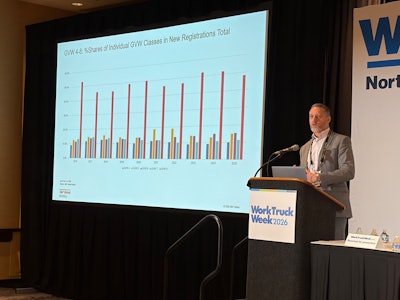
Divis confirmed Wednesday what Ford had touted the day before, that 2025 was a strong year for the medium-duty market leader. Divis said Class 4-6 registration data indicates Ford extended its large lead over other medium-duty truck makers last year thanks to its diversity of products and go-to-market approach, and its strength in a Class 6 market that was otherwise unremarkable.
And with registrations down across the Class 4-8 segments, Divis said Ford’s year was strong enough to pull it within striking distance of Freightliner across all five classes. Divis said a rebound in the Class 8 tractor space in 2026 would likely enable Freightliner to reverse some of that traction, but said until carriers return to purchasing in force heavy-duty OEMs will see overall market share losses to the more stable medium-duty segment.
He added Hino as the other medium-duty brand to notably grow market share last year.
[RELATED: Spec’ing your customers for success when choosing an engine]
Divis also noted of the top five vocational registrations categories — lease/rental, general freight, services, construction and government — only government saw an uptick in vehicles in 2025. Expanding to the top 15 categories, Divis said only six were in the black, showcasing how visible the uncertainty that defined the year was on sales.

Wrobel says NTEA data indicates overall truck and chassis sales were down 6.3% year over year in 2025, with most of that slip coming in the second half of the year in the van and tractor space. In the fourth quarter, specifically, Wrobel said van sales were down 26% while tractors were off by 23.3% against the same quarter in 2024.
 NTEA's Andrew Wrobel discusses economic indicators that put pressure on commercial vehicle demand during Work Truck Week 2026 Wednesday in Indianapolis.
2026 optimism exists but stronger sales aren’t guaranteed
Wrobel said if there’s one positive the market could point to entering 2026, it was inventories. The sales declines of the second half enabled manufacturers to begin realigning their orders to shipment rates, normalizing backlogs and bringing on-lot numbers to more manageable totals.
He also thought, until the beginning of the recent conflict in Iran, that the global and U.S. economies were appearing less uncertain and that business conditions were improving for the months ahead.
Divis gave a similar outlook. He said S&P is hopeful the military action in Iran concludes in the coming weeks and the global economy reacts with relief and stability. Wrobel noted the price for a barrel of oil nearly doubled last week (but has since receded) and that volatility alone is enough to keep buyers out of the market for a little bit longer.
But Divis also notes carriers need to replenish their fleets. The average age of a commercial trucks rose to 12.8 years in 2025, the highest number seen since the Great Recession. Divis said customers are unlikely to stretch their trade cycles any longer than that unless they absolutely have to.
If the conflict in Iran is short-lived and the economic volatility it has created subsides, Wrobel said NTEA’s baseline projection for commercial truck sales in 2026 up 6% year over year. If things get worse in the Middle East, or tariffs or some other factors cause distress, Wrobel’s pessimistic projection is up 1%. His optimistic, pre-buy driven projection is up 12%.