











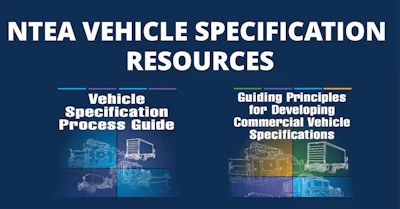
NTEA has introduced Guiding Principles for Developing Commercial Vehicle Specifications, a new foundational resource that outlines the core concepts behind effective commercial vehicle specification development.
NTEA also has released an enhanced Vehicle Specification Process Guide, an updated version of its member-exclusive resource that provides a step-by-step framework for planning, evaluating, and executing vehicle specifications.
Designed to work together, NTEA says these companion resources support industry professionals at every stage of the specification process — from understanding key principles to implementing a consistent, process-driven approach.
[RELATED: Don’t let poor spec guidance wound a customer relationship]
“Given the complexity of today’s commercial vehicles, it’s important to use an effective specification process when developing vehicle requirements,” says Chris Lyon, NTEA director of fleet relations. “These resources provide the foundation and the framework to help ensure nothing mission-critical is overlooked, while supporting practical, informed decision-making.”
Guiding Principles for Developing Commercial Vehicle Specifications
This new publication, available at no cost with an ntea.com account, provides an overview of the fundamentals behind developing effective commercial vehicle specifications.
As vehicle complexity continues to increase — driven by multi-stage manufacturing, evolving technology and specialized fleet applications — NTEA says this resource helps commercial vehicle professionals identify the key considerations that influence performance, safety, life cycle cost and regulatory compliance.
Providing industry-wide access to this guide reflects NTEA’s commitment to helping organizations develop more optimized, mission-specific, and efficient vehicles through a shared understanding of essential specification principles.
[RELATED: April truck orders outpace seasonal norms]
This foundational resource:
- Identifies key components of the specification process
- Outlines stakeholder roles and collaboration strategies
- Provides considerations for base vehicle and equipment requirements
- Highlights the importance of regulatory compliance and operational alignment
Vehicle Specification Process Guide
NTEA adds this advanced member-exclusive resource has been refreshed to provide a more robust, process-driven approach to specification development. Building on the concepts introduced in Guiding Principles, it delivers a practical framework that helps organizations plan, evaluate and execute specifications with clarity and consistency.

The updated guide:
- Maps a step-by-step workflow from defining requirements through procurement
- Incorporates decision loops, timelines and stakeholder inputs
- Provides guidance for evaluating existing fleet performance and new technologies
- Supports development of specifications that improve reliability, safety and total cost of ownership